This is an old revision of the document!
Warning: compact(): Undefined variable $format in /home/especiais/epsatisep/public_html/2022/EPS2022-wiki4/lib/plugins/numberedheadings/syntax.php on line 126
Warning: compact(): Undefined variable $format in /home/especiais/epsatisep/public_html/2022/EPS2022-wiki4/lib/plugins/numberedheadings/syntax.php on line 126
Warning: compact(): Undefined variable $format in /home/especiais/epsatisep/public_html/2022/EPS2022-wiki4/lib/plugins/numberedheadings/syntax.php on line 126
Warning: compact(): Undefined variable $format in /home/especiais/epsatisep/public_html/2022/EPS2022-wiki4/lib/plugins/numberedheadings/syntax.php on line 126
Warning: compact(): Undefined variable $format in /home/especiais/epsatisep/public_html/2022/EPS2022-wiki4/lib/plugins/numberedheadings/syntax.php on line 126
Warning: compact(): Undefined variable $format in /home/especiais/epsatisep/public_html/2022/EPS2022-wiki4/lib/plugins/numberedheadings/syntax.php on line 126
Warning: compact(): Undefined variable $format in /home/especiais/epsatisep/public_html/2022/EPS2022-wiki4/lib/plugins/numberedheadings/syntax.php on line 126
Warning: compact(): Undefined variable $format in /home/especiais/epsatisep/public_html/2022/EPS2022-wiki4/lib/plugins/numberedheadings/syntax.php on line 126
Warning: compact(): Undefined variable $format in /home/especiais/epsatisep/public_html/2022/EPS2022-wiki4/lib/plugins/numberedheadings/syntax.php on line 126
Warning: compact(): Undefined variable $format in /home/especiais/epsatisep/public_html/2022/EPS2022-wiki4/lib/plugins/numberedheadings/syntax.php on line 126
Warning: compact(): Undefined variable $format in /home/especiais/epsatisep/public_html/2022/EPS2022-wiki4/lib/plugins/numberedheadings/syntax.php on line 126
Warning: compact(): Undefined variable $format in /home/especiais/epsatisep/public_html/2022/EPS2022-wiki4/lib/plugins/numberedheadings/syntax.php on line 126
Warning: compact(): Undefined variable $format in /home/especiais/epsatisep/public_html/2022/EPS2022-wiki4/lib/plugins/numberedheadings/syntax.php on line 126
Warning: compact(): Undefined variable $format in /home/especiais/epsatisep/public_html/2022/EPS2022-wiki4/lib/plugins/numberedheadings/syntax.php on line 126
Warning: compact(): Undefined variable $format in /home/especiais/epsatisep/public_html/2022/EPS2022-wiki4/lib/plugins/numberedheadings/syntax.php on line 126
Warning: compact(): Undefined variable $format in /home/especiais/epsatisep/public_html/2022/EPS2022-wiki4/lib/plugins/numberedheadings/syntax.php on line 126
Warning: compact(): Undefined variable $format in /home/especiais/epsatisep/public_html/2022/EPS2022-wiki4/lib/plugins/numberedheadings/syntax.php on line 126
Warning: compact(): Undefined variable $format in /home/especiais/epsatisep/public_html/2022/EPS2022-wiki4/lib/plugins/numberedheadings/syntax.php on line 126
Warning: compact(): Undefined variable $format in /home/especiais/epsatisep/public_html/2022/EPS2022-wiki4/lib/plugins/numberedheadings/syntax.php on line 126
Warning: compact(): Undefined variable $format in /home/especiais/epsatisep/public_html/2022/EPS2022-wiki4/lib/plugins/numberedheadings/syntax.php on line 126
Warning: compact(): Undefined variable $format in /home/especiais/epsatisep/public_html/2022/EPS2022-wiki4/lib/plugins/numberedheadings/syntax.php on line 126
Warning: compact(): Undefined variable $format in /home/especiais/epsatisep/public_html/2022/EPS2022-wiki4/lib/plugins/numberedheadings/syntax.php on line 126
Warning: compact(): Undefined variable $format in /home/especiais/epsatisep/public_html/2022/EPS2022-wiki4/lib/plugins/numberedheadings/syntax.php on line 126
Warning: compact(): Undefined variable $format in /home/especiais/epsatisep/public_html/2022/EPS2022-wiki4/lib/plugins/numberedheadings/syntax.php on line 126
Warning: compact(): Undefined variable $format in /home/especiais/epsatisep/public_html/2022/EPS2022-wiki4/lib/plugins/numberedheadings/syntax.php on line 126
Warning: compact(): Undefined variable $format in /home/especiais/epsatisep/public_html/2022/EPS2022-wiki4/lib/plugins/numberedheadings/syntax.php on line 126
Warning: compact(): Undefined variable $format in /home/especiais/epsatisep/public_html/2022/EPS2022-wiki4/lib/plugins/numberedheadings/syntax.php on line 126
Warning: compact(): Undefined variable $format in /home/especiais/epsatisep/public_html/2022/EPS2022-wiki4/lib/plugins/numberedheadings/syntax.php on line 126
Warning: compact(): Undefined variable $format in /home/especiais/epsatisep/public_html/2022/EPS2022-wiki4/lib/plugins/numberedheadings/syntax.php on line 126
Warning: compact(): Undefined variable $format in /home/especiais/epsatisep/public_html/2022/EPS2022-wiki4/lib/plugins/numberedheadings/syntax.php on line 126
Warning: compact(): Undefined variable $format in /home/especiais/epsatisep/public_html/2022/EPS2022-wiki4/lib/plugins/numberedheadings/syntax.php on line 126
Warning: compact(): Undefined variable $format in /home/especiais/epsatisep/public_html/2022/EPS2022-wiki4/lib/plugins/numberedheadings/syntax.php on line 126
Warning: compact(): Undefined variable $format in /home/especiais/epsatisep/public_html/2022/EPS2022-wiki4/lib/plugins/numberedheadings/syntax.php on line 126
Warning: compact(): Undefined variable $format in /home/especiais/epsatisep/public_html/2022/EPS2022-wiki4/lib/plugins/numberedheadings/syntax.php on line 126
Warning: compact(): Undefined variable $format in /home/especiais/epsatisep/public_html/2022/EPS2022-wiki4/lib/plugins/numberedheadings/syntax.php on line 126
Warning: compact(): Undefined variable $format in /home/especiais/epsatisep/public_html/2022/EPS2022-wiki4/lib/plugins/numberedheadings/syntax.php on line 126
Warning: compact(): Undefined variable $format in /home/especiais/epsatisep/public_html/2022/EPS2022-wiki4/lib/plugins/numberedheadings/syntax.php on line 126
Warning: compact(): Undefined variable $format in /home/especiais/epsatisep/public_html/2022/EPS2022-wiki4/lib/plugins/numberedheadings/syntax.php on line 126
Warning: compact(): Undefined variable $format in /home/especiais/epsatisep/public_html/2022/EPS2022-wiki4/lib/plugins/numberedheadings/syntax.php on line 126
Warning: compact(): Undefined variable $format in /home/especiais/epsatisep/public_html/2022/EPS2022-wiki4/lib/plugins/numberedheadings/syntax.php on line 126
Warning: compact(): Undefined variable $format in /home/especiais/epsatisep/public_html/2022/EPS2022-wiki4/lib/plugins/numberedheadings/syntax.php on line 126
Warning: compact(): Undefined variable $format in /home/especiais/epsatisep/public_html/2022/EPS2022-wiki4/lib/plugins/numberedheadings/syntax.php on line 126
Warning: compact(): Undefined variable $format in /home/especiais/epsatisep/public_html/2022/EPS2022-wiki4/lib/plugins/numberedheadings/syntax.php on line 126
Warning: compact(): Undefined variable $format in /home/especiais/epsatisep/public_html/2022/EPS2022-wiki4/lib/plugins/numberedheadings/syntax.php on line 126
Warning: compact(): Undefined variable $format in /home/especiais/epsatisep/public_html/2022/EPS2022-wiki4/lib/plugins/numberedheadings/syntax.php on line 126
Warning: compact(): Undefined variable $format in /home/especiais/epsatisep/public_html/2022/EPS2022-wiki4/lib/plugins/numberedheadings/syntax.php on line 126
Warning: compact(): Undefined variable $format in /home/especiais/epsatisep/public_html/2022/EPS2022-wiki4/lib/plugins/numberedheadings/syntax.php on line 126
Warning: compact(): Undefined variable $format in /home/especiais/epsatisep/public_html/2022/EPS2022-wiki4/lib/plugins/numberedheadings/syntax.php on line 126
Warning: compact(): Undefined variable $format in /home/especiais/epsatisep/public_html/2022/EPS2022-wiki4/lib/plugins/numberedheadings/syntax.php on line 126
Warning: compact(): Undefined variable $format in /home/especiais/epsatisep/public_html/2022/EPS2022-wiki4/lib/plugins/numberedheadings/syntax.php on line 126
Warning: compact(): Undefined variable $format in /home/especiais/epsatisep/public_html/2022/EPS2022-wiki4/lib/plugins/numberedheadings/syntax.php on line 126
Warning: compact(): Undefined variable $format in /home/especiais/epsatisep/public_html/2022/EPS2022-wiki4/lib/plugins/numberedheadings/syntax.php on line 126
Warning: compact(): Undefined variable $format in /home/especiais/epsatisep/public_html/2022/EPS2022-wiki4/lib/plugins/numberedheadings/syntax.php on line 126
Warning: compact(): Undefined variable $format in /home/especiais/epsatisep/public_html/2022/EPS2022-wiki4/lib/plugins/numberedheadings/syntax.php on line 126
Warning: compact(): Undefined variable $format in /home/especiais/epsatisep/public_html/2022/EPS2022-wiki4/lib/plugins/numberedheadings/syntax.php on line 126
Warning: compact(): Undefined variable $format in /home/especiais/epsatisep/public_html/2022/EPS2022-wiki4/lib/plugins/numberedheadings/syntax.php on line 126
Warning: compact(): Undefined variable $format in /home/especiais/epsatisep/public_html/2022/EPS2022-wiki4/lib/plugins/numberedheadings/syntax.php on line 126
Warning: compact(): Undefined variable $format in /home/especiais/epsatisep/public_html/2022/EPS2022-wiki4/lib/plugins/numberedheadings/syntax.php on line 126
Warning: compact(): Undefined variable $format in /home/especiais/epsatisep/public_html/2022/EPS2022-wiki4/lib/plugins/numberedheadings/syntax.php on line 126
Warning: compact(): Undefined variable $format in /home/especiais/epsatisep/public_html/2022/EPS2022-wiki4/lib/plugins/numberedheadings/syntax.php on line 126
Warning: compact(): Undefined variable $format in /home/especiais/epsatisep/public_html/2022/EPS2022-wiki4/lib/plugins/numberedheadings/syntax.php on line 126
Warning: compact(): Undefined variable $format in /home/especiais/epsatisep/public_html/2022/EPS2022-wiki4/lib/plugins/numberedheadings/syntax.php on line 126
Warning: compact(): Undefined variable $format in /home/especiais/epsatisep/public_html/2022/EPS2022-wiki4/lib/plugins/numberedheadings/syntax.php on line 126
Warning: compact(): Undefined variable $format in /home/especiais/epsatisep/public_html/2022/EPS2022-wiki4/lib/plugins/numberedheadings/syntax.php on line 126
Warning: compact(): Undefined variable $format in /home/especiais/epsatisep/public_html/2022/EPS2022-wiki4/lib/plugins/numberedheadings/syntax.php on line 126
Warning: compact(): Undefined variable $format in /home/especiais/epsatisep/public_html/2022/EPS2022-wiki4/lib/plugins/numberedheadings/syntax.php on line 126
Warning: compact(): Undefined variable $format in /home/especiais/epsatisep/public_html/2022/EPS2022-wiki4/lib/plugins/numberedheadings/syntax.php on line 126
Warning: compact(): Undefined variable $format in /home/especiais/epsatisep/public_html/2022/EPS2022-wiki4/lib/plugins/numberedheadings/syntax.php on line 126
Warning: compact(): Undefined variable $format in /home/especiais/epsatisep/public_html/2022/EPS2022-wiki4/lib/plugins/numberedheadings/syntax.php on line 126
Warning: compact(): Undefined variable $format in /home/especiais/epsatisep/public_html/2022/EPS2022-wiki4/lib/plugins/numberedheadings/syntax.php on line 126
Warning: compact(): Undefined variable $format in /home/especiais/epsatisep/public_html/2022/EPS2022-wiki4/lib/plugins/numberedheadings/syntax.php on line 126
Warning: compact(): Undefined variable $format in /home/especiais/epsatisep/public_html/2022/EPS2022-wiki4/lib/plugins/numberedheadings/syntax.php on line 126
Warning: compact(): Undefined variable $format in /home/especiais/epsatisep/public_html/2022/EPS2022-wiki4/lib/plugins/numberedheadings/syntax.php on line 126
Warning: compact(): Undefined variable $format in /home/especiais/epsatisep/public_html/2022/EPS2022-wiki4/lib/plugins/numberedheadings/syntax.php on line 126
Warning: compact(): Undefined variable $format in /home/especiais/epsatisep/public_html/2022/EPS2022-wiki4/lib/plugins/numberedheadings/syntax.php on line 126
Warning: compact(): Undefined variable $format in /home/especiais/epsatisep/public_html/2022/EPS2022-wiki4/lib/plugins/numberedheadings/syntax.php on line 126
Warning: compact(): Undefined variable $format in /home/especiais/epsatisep/public_html/2022/EPS2022-wiki4/lib/plugins/numberedheadings/syntax.php on line 126
Warning: compact(): Undefined variable $format in /home/especiais/epsatisep/public_html/2022/EPS2022-wiki4/lib/plugins/numberedheadings/syntax.php on line 126
Warning: compact(): Undefined variable $format in /home/especiais/epsatisep/public_html/2022/EPS2022-wiki4/lib/plugins/numberedheadings/syntax.php on line 126
Warning: compact(): Undefined variable $format in /home/especiais/epsatisep/public_html/2022/EPS2022-wiki4/lib/plugins/numberedheadings/syntax.php on line 126
Warning: compact(): Undefined variable $format in /home/especiais/epsatisep/public_html/2022/EPS2022-wiki4/lib/plugins/numberedheadings/syntax.php on line 126
Warning: compact(): Undefined variable $format in /home/especiais/epsatisep/public_html/2022/EPS2022-wiki4/lib/plugins/numberedheadings/syntax.php on line 126
Warning: compact(): Undefined variable $format in /home/especiais/epsatisep/public_html/2022/EPS2022-wiki4/lib/plugins/numberedheadings/syntax.php on line 126
Warning: compact(): Undefined variable $format in /home/especiais/epsatisep/public_html/2022/EPS2022-wiki4/lib/plugins/numberedheadings/syntax.php on line 126
Warning: compact(): Undefined variable $format in /home/especiais/epsatisep/public_html/2022/EPS2022-wiki4/lib/plugins/numberedheadings/syntax.php on line 126
Warning: compact(): Undefined variable $format in /home/especiais/epsatisep/public_html/2022/EPS2022-wiki4/lib/plugins/numberedheadings/syntax.php on line 126
Warning: compact(): Undefined variable $format in /home/especiais/epsatisep/public_html/2022/EPS2022-wiki4/lib/plugins/numberedheadings/syntax.php on line 126
Warning: compact(): Undefined variable $format in /home/especiais/epsatisep/public_html/2022/EPS2022-wiki4/lib/plugins/numberedheadings/syntax.php on line 126
Warning: compact(): Undefined variable $format in /home/especiais/epsatisep/public_html/2022/EPS2022-wiki4/lib/plugins/numberedheadings/syntax.php on line 126
Warning: compact(): Undefined variable $format in /home/especiais/epsatisep/public_html/2022/EPS2022-wiki4/lib/plugins/numberedheadings/syntax.php on line 126
Warning: compact(): Undefined variable $format in /home/especiais/epsatisep/public_html/2022/EPS2022-wiki4/lib/plugins/numberedheadings/syntax.php on line 126
Warning: compact(): Undefined variable $format in /home/especiais/epsatisep/public_html/2022/EPS2022-wiki4/lib/plugins/numberedheadings/syntax.php on line 126
Warning: compact(): Undefined variable $format in /home/especiais/epsatisep/public_html/2022/EPS2022-wiki4/lib/plugins/numberedheadings/syntax.php on line 126
Warning: compact(): Undefined variable $format in /home/especiais/epsatisep/public_html/2022/EPS2022-wiki4/lib/plugins/numberedheadings/syntax.php on line 126
Warning: compact(): Undefined variable $format in /home/especiais/epsatisep/public_html/2022/EPS2022-wiki4/lib/plugins/numberedheadings/syntax.php on line 126
Warning: compact(): Undefined variable $format in /home/especiais/epsatisep/public_html/2022/EPS2022-wiki4/lib/plugins/numberedheadings/syntax.php on line 126
Warning: compact(): Undefined variable $format in /home/especiais/epsatisep/public_html/2022/EPS2022-wiki4/lib/plugins/numberedheadings/syntax.php on line 126
Warning: compact(): Undefined variable $format in /home/especiais/epsatisep/public_html/2022/EPS2022-wiki4/lib/plugins/numberedheadings/syntax.php on line 126
Warning: compact(): Undefined variable $format in /home/especiais/epsatisep/public_html/2022/EPS2022-wiki4/lib/plugins/numberedheadings/syntax.php on line 126
Warning: compact(): Undefined variable $format in /home/especiais/epsatisep/public_html/2022/EPS2022-wiki4/lib/plugins/numberedheadings/syntax.php on line 126
Warning: compact(): Undefined variable $format in /home/especiais/epsatisep/public_html/2022/EPS2022-wiki4/lib/plugins/numberedheadings/syntax.php on line 126
Warning: compact(): Undefined variable $format in /home/especiais/epsatisep/public_html/2022/EPS2022-wiki4/lib/plugins/numberedheadings/syntax.php on line 126
Warning: compact(): Undefined variable $format in /home/especiais/epsatisep/public_html/2022/EPS2022-wiki4/lib/plugins/numberedheadings/syntax.php on line 126
Warning: compact(): Undefined variable $format in /home/especiais/epsatisep/public_html/2022/EPS2022-wiki4/lib/plugins/numberedheadings/syntax.php on line 126
Warning: compact(): Undefined variable $format in /home/especiais/epsatisep/public_html/2022/EPS2022-wiki4/lib/plugins/numberedheadings/syntax.php on line 126
Warning: compact(): Undefined variable $format in /home/especiais/epsatisep/public_html/2022/EPS2022-wiki4/lib/plugins/numberedheadings/syntax.php on line 126
Warning: compact(): Undefined variable $format in /home/especiais/epsatisep/public_html/2022/EPS2022-wiki4/lib/plugins/numberedheadings/syntax.php on line 126
Warning: compact(): Undefined variable $format in /home/especiais/epsatisep/public_html/2022/EPS2022-wiki4/lib/plugins/numberedheadings/syntax.php on line 126
Warning: compact(): Undefined variable $format in /home/especiais/epsatisep/public_html/2022/EPS2022-wiki4/lib/plugins/numberedheadings/syntax.php on line 126
Warning: compact(): Undefined variable $format in /home/especiais/epsatisep/public_html/2022/EPS2022-wiki4/lib/plugins/numberedheadings/syntax.php on line 126
Warning: compact(): Undefined variable $format in /home/especiais/epsatisep/public_html/2022/EPS2022-wiki4/lib/plugins/numberedheadings/syntax.php on line 126
Warning: compact(): Undefined variable $format in /home/especiais/epsatisep/public_html/2022/EPS2022-wiki4/lib/plugins/numberedheadings/syntax.php on line 126
Warning: compact(): Undefined variable $format in /home/especiais/epsatisep/public_html/2022/EPS2022-wiki4/lib/plugins/numberedheadings/syntax.php on line 126
Warning: compact(): Undefined variable $format in /home/especiais/epsatisep/public_html/2022/EPS2022-wiki4/lib/plugins/numberedheadings/syntax.php on line 126
Warning: compact(): Undefined variable $format in /home/especiais/epsatisep/public_html/2022/EPS2022-wiki4/lib/plugins/numberedheadings/syntax.php on line 126
Warning: compact(): Undefined variable $format in /home/especiais/epsatisep/public_html/2022/EPS2022-wiki4/lib/plugins/numberedheadings/syntax.php on line 126
Warning: compact(): Undefined variable $format in /home/especiais/epsatisep/public_html/2022/EPS2022-wiki4/lib/plugins/numberedheadings/syntax.php on line 126
Warning: compact(): Undefined variable $format in /home/especiais/epsatisep/public_html/2022/EPS2022-wiki4/lib/plugins/numberedheadings/syntax.php on line 126
Warning: compact(): Undefined variable $format in /home/especiais/epsatisep/public_html/2022/EPS2022-wiki4/lib/plugins/numberedheadings/syntax.php on line 126
Warning: compact(): Undefined variable $format in /home/especiais/epsatisep/public_html/2022/EPS2022-wiki4/lib/plugins/numberedheadings/syntax.php on line 126
Warning: compact(): Undefined variable $format in /home/especiais/epsatisep/public_html/2022/EPS2022-wiki4/lib/plugins/numberedheadings/syntax.php on line 126
Warning: compact(): Undefined variable $format in /home/especiais/epsatisep/public_html/2022/EPS2022-wiki4/lib/plugins/numberedheadings/syntax.php on line 126
Warning: compact(): Undefined variable $format in /home/especiais/epsatisep/public_html/2022/EPS2022-wiki4/lib/plugins/numberedheadings/syntax.php on line 126
Warning: compact(): Undefined variable $format in /home/especiais/epsatisep/public_html/2022/EPS2022-wiki4/lib/plugins/numberedheadings/syntax.php on line 126
Warning: compact(): Undefined variable $format in /home/especiais/epsatisep/public_html/2022/EPS2022-wiki4/lib/plugins/numberedheadings/syntax.php on line 126
Warning: compact(): Undefined variable $format in /home/especiais/epsatisep/public_html/2022/EPS2022-wiki4/lib/plugins/numberedheadings/syntax.php on line 126
Warning: compact(): Undefined variable $format in /home/especiais/epsatisep/public_html/2022/EPS2022-wiki4/lib/plugins/numberedheadings/syntax.php on line 126
Warning: compact(): Undefined variable $format in /home/especiais/epsatisep/public_html/2022/EPS2022-wiki4/lib/plugins/numberedheadings/syntax.php on line 126
Warning: compact(): Undefined variable $format in /home/especiais/epsatisep/public_html/2022/EPS2022-wiki4/lib/plugins/numberedheadings/syntax.php on line 126
Warning: compact(): Undefined variable $format in /home/especiais/epsatisep/public_html/2022/EPS2022-wiki4/lib/plugins/numberedheadings/syntax.php on line 126
Warning: compact(): Undefined variable $format in /home/especiais/epsatisep/public_html/2022/EPS2022-wiki4/lib/plugins/numberedheadings/syntax.php on line 126
Warning: compact(): Undefined variable $format in /home/especiais/epsatisep/public_html/2022/EPS2022-wiki4/lib/plugins/numberedheadings/syntax.php on line 126
Warning: compact(): Undefined variable $format in /home/especiais/epsatisep/public_html/2022/EPS2022-wiki4/lib/plugins/numberedheadings/syntax.php on line 126
Warning: compact(): Undefined variable $format in /home/especiais/epsatisep/public_html/2022/EPS2022-wiki4/lib/plugins/numberedheadings/syntax.php on line 126
Warning: compact(): Undefined variable $format in /home/especiais/epsatisep/public_html/2022/EPS2022-wiki4/lib/plugins/numberedheadings/syntax.php on line 126
Warning: compact(): Undefined variable $format in /home/especiais/epsatisep/public_html/2022/EPS2022-wiki4/lib/plugins/numberedheadings/syntax.php on line 126
Warning: compact(): Undefined variable $format in /home/especiais/epsatisep/public_html/2022/EPS2022-wiki4/lib/plugins/numberedheadings/syntax.php on line 126
Warning: compact(): Undefined variable $format in /home/especiais/epsatisep/public_html/2022/EPS2022-wiki4/lib/plugins/numberedheadings/syntax.php on line 126
Warning: compact(): Undefined variable $format in /home/especiais/epsatisep/public_html/2022/EPS2022-wiki4/lib/plugins/numberedheadings/syntax.php on line 126
Warning: compact(): Undefined variable $format in /home/especiais/epsatisep/public_html/2022/EPS2022-wiki4/lib/plugins/numberedheadings/syntax.php on line 126
Warning: compact(): Undefined variable $format in /home/especiais/epsatisep/public_html/2022/EPS2022-wiki4/lib/plugins/numberedheadings/syntax.php on line 126
Warning: compact(): Undefined variable $format in /home/especiais/epsatisep/public_html/2022/EPS2022-wiki4/lib/plugins/numberedheadings/syntax.php on line 126
Warning: compact(): Undefined variable $format in /home/especiais/epsatisep/public_html/2022/EPS2022-wiki4/lib/plugins/numberedheadings/syntax.php on line 126
Warning: compact(): Undefined variable $format in /home/especiais/epsatisep/public_html/2022/EPS2022-wiki4/lib/plugins/numberedheadings/syntax.php on line 126
Warning: compact(): Undefined variable $format in /home/especiais/epsatisep/public_html/2022/EPS2022-wiki4/lib/plugins/numberedheadings/syntax.php on line 126
Warning: compact(): Undefined variable $format in /home/especiais/epsatisep/public_html/2022/EPS2022-wiki4/lib/plugins/numberedheadings/syntax.php on line 126
Warning: compact(): Undefined variable $format in /home/especiais/epsatisep/public_html/2022/EPS2022-wiki4/lib/plugins/numberedheadings/syntax.php on line 126
Warning: compact(): Undefined variable $format in /home/especiais/epsatisep/public_html/2022/EPS2022-wiki4/lib/plugins/numberedheadings/syntax.php on line 126
Warning: compact(): Undefined variable $format in /home/especiais/epsatisep/public_html/2022/EPS2022-wiki4/lib/plugins/numberedheadings/syntax.php on line 126
Warning: compact(): Undefined variable $format in /home/especiais/epsatisep/public_html/2022/EPS2022-wiki4/lib/plugins/numberedheadings/syntax.php on line 126
Warning: compact(): Undefined variable $format in /home/especiais/epsatisep/public_html/2022/EPS2022-wiki4/lib/plugins/numberedheadings/syntax.php on line 126
Warning: compact(): Undefined variable $format in /home/especiais/epsatisep/public_html/2022/EPS2022-wiki4/lib/plugins/numberedheadings/syntax.php on line 126
Warning: compact(): Undefined variable $format in /home/especiais/epsatisep/public_html/2022/EPS2022-wiki4/lib/plugins/numberedheadings/syntax.php on line 126
Warning: compact(): Undefined variable $format in /home/especiais/epsatisep/public_html/2022/EPS2022-wiki4/lib/plugins/numberedheadings/syntax.php on line 126
Warning: compact(): Undefined variable $format in /home/especiais/epsatisep/public_html/2022/EPS2022-wiki4/lib/plugins/numberedheadings/syntax.php on line 126
Warning: compact(): Undefined variable $format in /home/especiais/epsatisep/public_html/2022/EPS2022-wiki4/lib/plugins/numberedheadings/syntax.php on line 126
Warning: compact(): Undefined variable $format in /home/especiais/epsatisep/public_html/2022/EPS2022-wiki4/lib/plugins/numberedheadings/syntax.php on line 126
Warning: compact(): Undefined variable $format in /home/especiais/epsatisep/public_html/2022/EPS2022-wiki4/lib/plugins/numberedheadings/syntax.php on line 126
Warning: compact(): Undefined variable $format in /home/especiais/epsatisep/public_html/2022/EPS2022-wiki4/lib/plugins/numberedheadings/syntax.php on line 126
Warning: compact(): Undefined variable $format in /home/especiais/epsatisep/public_html/2022/EPS2022-wiki4/lib/plugins/numberedheadings/syntax.php on line 126
Warning: compact(): Undefined variable $format in /home/especiais/epsatisep/public_html/2022/EPS2022-wiki4/lib/plugins/numberedheadings/syntax.php on line 126
Warning: compact(): Undefined variable $format in /home/especiais/epsatisep/public_html/2022/EPS2022-wiki4/lib/plugins/numberedheadings/syntax.php on line 126
Warning: compact(): Undefined variable $format in /home/especiais/epsatisep/public_html/2022/EPS2022-wiki4/lib/plugins/numberedheadings/syntax.php on line 126
Warning: compact(): Undefined variable $format in /home/especiais/epsatisep/public_html/2022/EPS2022-wiki4/lib/plugins/numberedheadings/syntax.php on line 126
Warning: Trying to access array offset on null in /home/especiais/epsatisep/public_html/2022/EPS2022-wiki4/lib/plugins/caption/syntax/reference.php on line 68
Warning: Undefined array key "flabel1" in /home/especiais/epsatisep/public_html/2022/EPS2022-wiki4/lib/plugins/caption/syntax/reference.php on line 68
Warning: Undefined array key "flabel2" in /home/especiais/epsatisep/public_html/2022/EPS2022-wiki4/lib/plugins/caption/syntax/reference.php on line 68
Warning: Undefined array key "tlabel1" in /home/especiais/epsatisep/public_html/2022/EPS2022-wiki4/lib/plugins/caption/syntax/reference.php on line 68
Warning: Undefined array key "flabel3" in /home/especiais/epsatisep/public_html/2022/EPS2022-wiki4/lib/plugins/caption/syntax/reference.php on line 68
Warning: Undefined array key "flabel4" in /home/especiais/epsatisep/public_html/2022/EPS2022-wiki4/lib/plugins/caption/syntax/reference.php on line 68
Warning: Undefined array key "flabel4" in /home/especiais/epsatisep/public_html/2022/EPS2022-wiki4/lib/plugins/caption/syntax/reference.php on line 68
Warning: Undefined array key "tlabel2" in /home/especiais/epsatisep/public_html/2022/EPS2022-wiki4/lib/plugins/caption/syntax/reference.php on line 68
Warning: Undefined array key "tlabel3" in /home/especiais/epsatisep/public_html/2022/EPS2022-wiki4/lib/plugins/caption/syntax/reference.php on line 68
Warning: Undefined array key "flabel5" in /home/especiais/epsatisep/public_html/2022/EPS2022-wiki4/lib/plugins/caption/syntax/reference.php on line 68
Warning: Undefined array key "flabel5" in /home/especiais/epsatisep/public_html/2022/EPS2022-wiki4/lib/plugins/caption/syntax/reference.php on line 68
Warning: Undefined array key "flabel6" in /home/especiais/epsatisep/public_html/2022/EPS2022-wiki4/lib/plugins/caption/syntax/reference.php on line 68
Warning: Undefined array key "flabel7" in /home/especiais/epsatisep/public_html/2022/EPS2022-wiki4/lib/plugins/caption/syntax/reference.php on line 68
Warning: Undefined array key "tlabel4" in /home/especiais/epsatisep/public_html/2022/EPS2022-wiki4/lib/plugins/caption/syntax/reference.php on line 68
Warning: Undefined array key "tlabel5" in /home/especiais/epsatisep/public_html/2022/EPS2022-wiki4/lib/plugins/caption/syntax/reference.php on line 68
Warning: Undefined array key "tlabel6" in /home/especiais/epsatisep/public_html/2022/EPS2022-wiki4/lib/plugins/caption/syntax/reference.php on line 68
Warning: Undefined array key "tlabel7" in /home/especiais/epsatisep/public_html/2022/EPS2022-wiki4/lib/plugins/caption/syntax/reference.php on line 68
Warning: Undefined array key "flabel8" in /home/especiais/epsatisep/public_html/2022/EPS2022-wiki4/lib/plugins/caption/syntax/reference.php on line 68
Warning: Undefined array key "tlabel8" in /home/especiais/epsatisep/public_html/2022/EPS2022-wiki4/lib/plugins/caption/syntax/reference.php on line 68
Warning: Undefined array key "tlabel9" in /home/especiais/epsatisep/public_html/2022/EPS2022-wiki4/lib/plugins/caption/syntax/reference.php on line 68
Warning: Undefined array key "flabel9" in /home/especiais/epsatisep/public_html/2022/EPS2022-wiki4/lib/plugins/caption/syntax/reference.php on line 68
Warning: Undefined array key "flabel10" in /home/especiais/epsatisep/public_html/2022/EPS2022-wiki4/lib/plugins/caption/syntax/reference.php on line 68
Warning: Undefined array key "flabel11" in /home/especiais/epsatisep/public_html/2022/EPS2022-wiki4/lib/plugins/caption/syntax/reference.php on line 68
Warning: Undefined array key "flabel12" in /home/especiais/epsatisep/public_html/2022/EPS2022-wiki4/lib/plugins/caption/syntax/reference.php on line 68
Warning: Undefined array key "flabel15" in /home/especiais/epsatisep/public_html/2022/EPS2022-wiki4/lib/plugins/caption/syntax/reference.php on line 68
Warning: Undefined array key "flabel17" in /home/especiais/epsatisep/public_html/2022/EPS2022-wiki4/lib/plugins/caption/syntax/reference.php on line 68
Warning: Undefined array key "flabel22" in /home/especiais/epsatisep/public_html/2022/EPS2022-wiki4/lib/plugins/caption/syntax/reference.php on line 68
Warning: Undefined array key "flabel23" in /home/especiais/epsatisep/public_html/2022/EPS2022-wiki4/lib/plugins/caption/syntax/reference.php on line 68
Warning: Undefined array key "flabel24" in /home/especiais/epsatisep/public_html/2022/EPS2022-wiki4/lib/plugins/caption/syntax/reference.php on line 68
Warning: Undefined array key "flabel27" in /home/especiais/epsatisep/public_html/2022/EPS2022-wiki4/lib/plugins/caption/syntax/reference.php on line 68
Warning: Undefined array key "flabel29" in /home/especiais/epsatisep/public_html/2022/EPS2022-wiki4/lib/plugins/caption/syntax/reference.php on line 68
Warning: Undefined array key "tlabel10" in /home/especiais/epsatisep/public_html/2022/EPS2022-wiki4/lib/plugins/caption/syntax/reference.php on line 68
Warning: Undefined array key "flabel36" in /home/especiais/epsatisep/public_html/2022/EPS2022-wiki4/lib/plugins/caption/syntax/reference.php on line 68
Warning: Undefined array key "flabel36" in /home/especiais/epsatisep/public_html/2022/EPS2022-wiki4/lib/plugins/caption/syntax/reference.php on line 68
Warning: Undefined array key "flabel38" in /home/especiais/epsatisep/public_html/2022/EPS2022-wiki4/lib/plugins/caption/syntax/reference.php on line 68
Warning: Undefined array key "flabel39" in /home/especiais/epsatisep/public_html/2022/EPS2022-wiki4/lib/plugins/caption/syntax/reference.php on line 68
Warning: Undefined array key "flabel40" in /home/especiais/epsatisep/public_html/2022/EPS2022-wiki4/lib/plugins/caption/syntax/reference.php on line 68
Warning: Undefined array key "flabel41" in /home/especiais/epsatisep/public_html/2022/EPS2022-wiki4/lib/plugins/caption/syntax/reference.php on line 68
Table of Contents
Report

Author(s)
- Alina Röhe
- Rose-Farah Blomme
- Thomas Hidding
- Zoé Domissy
- Zuzanna Marta Dylik
Acknowledgement
Glossary
| Abbreviation | Description |
|---|---|
| °C | Celsius |
| AV | Actual Value |
| CE | Common Era |
| CFI | Corporate Finance Institute |
| cm | centimeter |
| CMYK | Cyan Magenta Yellow Black |
| CO2 | Carbon Dioxide |
| COPI | Control of Patient Information |
| DC | Direct Current |
| EC | European Commission |
| EEPROM | Electronically Erasable Programmable Read-only Memory |
| EPS | European Project Semester |
| EU | European Union |
| EV | Earned Value |
| EVM | Earned Value Management |
| g | Gram |
| GPIO | General Purpose Input/Output |
| I/O | Input/Output |
| ISEP | Instituto Superior de Engenharia do Porto |
| kB | Kilobyte |
| LA | Leak Alarm |
| LED | Light Emitting Diode |
| m | Metre |
| mA | Miliampere |
| MAX | MAximum |
| MB | Megabyte |
| MHz | Megahertz |
| mm | Milimetre |
| ms | Miliseconds |
| NSPE | National Society of Professional Engineers |
| OE | Order of Engineers |
| PESTLE | Political Economic Social Technological Environmental Legal |
| PHY | Physical Layer |
| PIO | Public Information Office |
| PWM | Pulse-width Modulation |
| QSPI | Queued Serial Peripheral Interface |
| RPM | Revolutions Per Minute |
| RX | Receive |
| SCL | Spam Confidence Level |
| SDA | Serial Data Line |
| SPI | Serial Peripheral Interface |
| SRAM | Static Random Access Memory |
| SWOT | Strengths Weaknesses Opportunities Threats |
| TX | Transmit |
| TX | Transmit |
| UART | Universal Asynchronous Receiver Transmitter |
| USB | Universal Serial Bus |
| V | Voltage |
| W | Watt |
| WBS | Work Breakdown Structure |
1. Introduction
This report describes all the steps that reflect the work and research done by Team 4 for the European Project Semester at Instituto Superior de Engenharia do Porto. EPS is a project during the second semester of 2022. This project gives the students a chance to create a product-system in a multidisciplinary group and hopes to foster the kind of team-working skills sought after by employers.
1.1 Presentation
The team consists of five international students with various backgrounds. These five students combine their knowledge and skills to come up with a solution that demonstrates the symbiosis between fish and algae. The personal information of the different team members can be found in Table 1 below.
| Name | Field of Study | Country |
|---|---|---|
| Alina Röhe | Mechanical Engineering | Germany |
| Rose-Farah Blomme | Product Development | Belgium |
| Thomas Hidding | Chemical Technology | The Netherlands |
| Zoé Domissy | Packaging Engineering | France |
| Zuzanna Marta Dylik | Civil Engineering | Poland |
1.2 Motivation
The motivation to participate in the European Project Semester for the team members can be found in several factors. The most obvious and already mentioned is the opportunity to step out of our comfort zone and participate in a group work with students from very diverse fields. This provides a nuanced experience. We hope that collaborating with members of different cultures and disciplines can provide us with new insights and ways of working, but also helps us on a social level. Not only is the groupwork a new experience, but the project is also based on a topic that is completely new to all of us. With this semester we can learn from a new culture, language and environment to provide us with a broader view on our society and possibly even on our own home environment. Besides all these new experiences and adventures, we have also chosen EPS to improve our English.
At the end of this semester, we hope to be able to present a product that demonstrates the symbiosis between fish and algae in order to contribute to the new environmental future.
1.3 Problem
The growth of population causes a lot of problems for planet Earth. We are already using way more natural resources than the Earth can replenish. This also includes the demand of food which is growing with peoples’ needs. The consumption is unimaginably high, that is why it is so important to focus on finding solutions for sustainable ways of getting supplies that we need without causing any more damage [T. Nace, 2017]. Combining algae and fish for farming purposes allows to replenish the food supplies faster than the ocean can produce. However, it is important to remember that not all of the fish farms run in a sustainable way. A lot of them cause environmental damage: they consist of huge amounts of fish concentrated in one small area and when these fish excrete waste or die, they are polluting the surrounding waters [B. Shields, 2017]. It should be mentioned, that lots of fish farms do not care about the quality of food that is used for fish. Most of them are loaded with pesticides and other chemicals just to make them grow faster or achieve more effective results [B., Henkelmann M. Freitas Rebelo O. Malm J.P. Machado Torres D. Botaro, K.W. Schramm, 2011]. Moreover, wild fish also suffer from pesticides that are located in food that is used for fish in farms. Studies show that wild fish that are continuously feeding on leftover of pellets near fish farms, may be vulnerable to organophosphorus pesticides [M. Sanden F. Yadetie O.A. Karlsen A. Goksøyr M.H.G. Berntssen A.K. Larsen P.A. Olsvik, T. Kristensen, 2019].
The combination of algae and fish farming is supposed to prevent the long supply chains with unknown food origins. Fish provide algae with nutrients that they need to grow. We use the algae to produce food. Algae on the other hand, filter the water so fish stay alive. Our goal is to focus on algae as a source of food and not to harm fish. Both algae and fish farms are supposed to ensure nutritional provisions as they are loaded with proteins, omega-3 fatty acids and other nutrients. Studies show that the main source of all the nutrients and omega-3 oils that help our brains to function better can come directly from algae, without including fish in this food chain [Y. Li F. Vernen M. Timmins D. K. Lim T. C. Adarme-Vega, P.M. Schenk, 2012]. Algae oils may provide a great plant-based alternative. These are the factors we want to include in our project, sustainability is one main ones.
1.4 Objectives
The main goal of this project is to develop a system and product that include a symbiosis between fish and algae. This includes design, prototyping and testing. These different stages each have their own goal that we want to achieve within this project. The design of the aquaponic must include modularity, smartification, sustainability and value. Next to the design, there is also the construction of the product, which requires the use of sustainable materials and a proper construction so that each organism of the process has a safe environment. Finally, there is testing, which will hopefully result in a working prototype from the process.
1.5 Requirements
Project requirements:
- Maximum budget of 100 €
- Low-cost hardware solution
- Mandatory adoption of the International System of Units
- open-source software and technologies
Standard requirements: comply with the EU directives
- Machine Directive (2006/42/CE 2006-05-17)
- Electromagnetic Compatibility Directive (2004/108/EC 2004 12 15)
- Low Voltage Directive (2014/35/EU 2016-04-20)
- Radio Equipment Directive (2014/53/EU 2014-04-16)
- Restriction of Hazardous Substances (ROHS) in Electrical and Electronic Equipment Directive (2002/95/EC 2003-01-27)
Functional requirements:
- Sustainable materials
- Recyclable components.
- Efficient to maintain
- Easy installation
- Modularity (multiple configurations, sizes, possible to to replace individual parts)
1.6 Functional Tests
To make sure components and connections between them work correctly it is necessary to conduct number of tests which help specify proper operation of the system.
Two key aspects need to be checked in the Arduino program: correct functioning of the appearing notifications about water level and value of the temperature in the fish tank, as well as correct functioning of light and pump switches.
What is more, the test that is needed to be performed is to check if the assembled system works correctly, above all: pipes’ connections, water filters and general flow of the water between two tanks.
1.7 Project Planning
Project Planning is developed according to Agile and Scrum methodologies (Figure 1). With this method, the multitude of activities and steps in a project can be well divided and handled in different design sprints. The team will create a forced ranked project backlog. This is a list of tasks that need to be completed during the project. These are ranked by priority (pulling forward critical phases). The team will decide for a certain time period to finish these tasks. This is considered the sprint plan. Per sprint you have sprint backlogs, consisting of backlog tasks which must be included in the project during that particular sprint. Sprint backlogs are translated into sprint tasks. These sprint tasks describe how the items should be processed in the design. By working with sprints and specific backlogs it becomes clear what is included and what is not (avoiding scope creep). In order to keep track of each other's tasks and completed activities, we have chosen to work with Microsoft planner. This allows each group member to view and update his or her own tasks in an efficient manner. This can be seen in Figure 2. The SCRUM team meets regularly in between. They have a team meeting every day in which each team member tells what he/she is doing and will be doing. During the retrospective meetings, the team discusses how the previous sprint went and how they can improve their teamwork.


1.8 Report Structure
The eight main chapters of the report all listed below in Table 2, with a brief description of the contents of each chapter.
| Chapters | Description | |
|---|---|---|
| 1 | Introduction | In this first chapter, the team members are presented and there is a first introduction to the project. Specifically, the problem definition , what we want to achieve and what resources we would need to do so. |
| 2 | State of Art | This section contains our research. All the background information that explores the different areas in which we could go forward with our project and the possibilities that are involved. |
| 3 | Project Management | A summary of the use of SCRUM and Agile management throughout this project. |
| 4 | Marketing Plan | Reflects the research of the market in which our product would up be positioned / sold, the target group we want to focus on and the strategy we could use when implementing our product in the market. |
| 5 | Eco-efficiency Measures for Sustainability | The fifth chapter is an analysis of the impact that our product could have on an ecological, economic and social level, in order to make our product as sustainable as possible. |
| 6 | Ethical and Deontological Concerns | This chapter also analyses the various ethical challenges associated with our product and the possible solutions to them. |
| 7 | Project Development | It shows everything that is closely related to the product. The different concepts and the related sketches, the product architecture of the final concept, the items to be developed, materials to be used… Etc. |
| 8 | Conclusions | A summary of the document and of the work we have done, together with possible future plans regarding our product. |
2. State of the Art
2.1 Introduction
It is not possible to delve deeper into this topic and the organisms involved until it is clear what exactly a symbiosis is. A symbiosis is an umbrella term for various relationships between two or more individuals of different species. This can have benefits for the parties involved, but in some forms this relationship has a negative effect on one of the two or no effect at all [John R. Meyer, 2013]. The form of symbiosis that will be explored and utilized in this project is mutualism. This is an interaction between two symbionts in which both organisms experience benefits or even have some need for this relationship [J. Bascompte, 2019]. One component in this case is the fish, which provide nutrients with their excretions. These nutrients can be used for the growth of the algae. The algae, in turn, provide filtration of the water, which serves as the basis of life for the fish. Hence, a great advantage is the saving of necessary energy and resources which are normally required to supply the individual components of the system. To create a system that is as sustainable and efficient as possible, a fundamental analysis of the existing systems was therefore carried out. In addition, already existing market products are examined and placed in an overview. This allows us to analyse and compare what already exists. The various end products with harvested algae as starting point, are further analysed. The aim is to gather insights and retrieve input that helps us find the direction in which we will develop our product. Research into algae has become much more important in recent years because of their versatile components. Accordingly, the number of operational areas has increased significantly. Hence, the number of areas of application has also increased. This results in a wide range of applications for the use of algae grown in the symbiotic system.
2.2 Fish Farming
The world’s population grows, which means the demand for food increases. In this case the attention goes to seafood. The commercial fish aquaculture becomes increasingly popular as the fish stocks are declining in developed and still developing countries. Caged fish farming releases uneaten fish feeds, faeces, and soluble fish wastes into the environment. Feeds are usually made of dry pellets or another, smaller types of fish, which have less value. They sink in the water column, settle on the seafloor, and are decomposed by bacteria and converted into dissolved organic matter and then demineralized into inorganic nutrients. These nutrients from fish excretion can cause phytoplankton growth. The consequence of that fact are the changes in phytoplankton biomass, algal blooms, phytoplankton species composition. What is more, fish excrete nutrients such as ammonium and urea directly into the water, that is what makes them so important in the nutrient cycling. Exposure of nutrients depends on hydrodynamics, stratification, and sediment-water exchange.
The diagram of operation is presented in the Figure 3 below [Paul J. K. Yin, P.J. Harrison, 2014].

2.2.1 Nutrients
Figure 4 shows nutrients excreted by the fish in Nile Tilapia ponds during the fish removal process at intensive fish farming sites in the Western region of Paraná State in Brazil. This research however is not based on intensive fish farming and therefore the values in Figure 4 can only be used as an indication of which nutrients are released by fish in water with their respective ratio [P.A. Piana A. Gentelini B. Coldebella, P.F. Coldebella, 2017].

2.2.2 Scale
Depending on the scale of the process, there are numerous solutions to create a fish farm. To decide which solution is the best the following needs to be defined:
- The target markets
- Companies
- Schools
- Restaurants
- Own needs
- Size of the container
- Tank (Companies)
- Concrete cistern (Companies)
- Glass aquarium (Home / School / Restaurant)
- Type of water
- Salty water
- Fresh water
- Type of fish
- Industrial
- Ornamental
- Type of space
- Indoor
- Outdoor
2.2.3 Algae-eating fish types
Algae are plants and thrive in environments rich in water, light, and nutrients. This makes aquariums a perfect breeding ground. A huge amount of light and nutrients in the water will cause algae to grow rapidly [K. Claussen, 2021]. Multiple things can be done to prevent or rectify an algae overgrowth situation: reducing light, feed less to decrease the phosphate level, change the water regularly, keep living plants or keep algae-eating fish [S. Sharpe, 2020]. There are various types of fish that can be used for this purpose.
Table 2 shows the various types of fresh water fish that can be used for this purpose.
| Common name | Origin | Life expectancy (years) | Description |
|---|---|---|---|
| Bristlenose Pleco | Amazon, rapid-flowing tributaries | 5 | Grow to be only around 4 inches long, available in different colours, namely gold and albino. Feels best in aquariums with driftwood and plenty of hiding spots [S. Sharpe, 2022]. |
| Siamese Algae Eate | Southeast Asia | 10 | Generally peaceful nature and ability to eat and control a wide range of algae (including the brown algae) makes them an asset to almost any aquarium. Apart from algae, they control flatworm population and eat leftover detritus in the aquarium [R. Woods, 2018]. |
| Chinese Algae Eater | Thailand, Vietnam, Laos | 7-10 | The older they get, the more aggressive they become, that is why they should not be kept in community tank. They can reach about 10 inches long, what helps them survive with larger semi-aggressive fish tanks [R. Woods, 2022]. |
| Otocinclus Catfish | North Argentina, Venezuela | 3-5 | The smallest species, get up to 1,5 inches maximum. Suitable for community tanks and planted aquariums. They are particularly good at removing brown and green algae [R. Woods, 2019]. |
| Twig Catfish | Amazon, Orinoco, Paraná | 5-15 | Accept a variety of foods and quickly clear tanks of any green algae but requires the most care such as high oxygen level and pristine water quality in the aquariums. Because of their shy nature, they should not be kept with other species which can out-compete them for food [NualgiAquarium, 2016]. |
2.3 Algae Farming
Algae is an umbrella term for several organisms that can engage in photosynthesis. The close relationship between these organisms is not immediate, but some factors provide the link and distinguish this group from other life forms [J.A. Raven, M. Giordano, 2018]. They can exist as single, microscopic cells; they can be macroscopic and Multicellular and occur in widely varying sizes. Their habitat can also vary greatly, and they can occur in both freshwater and saltwater [A. Vidyasagar, 2016]. The largest groups of algae can be divided into two subgroups. The macroscopic algae, they are easily visible to the human eye and can again be split into three groups. The green algae (Chlorophyta), the red algae (Rhodophyta), and the brown algae (Phaeophyta). The latter two are mostly found (90%) in salt water as opposed to green algae, which are mainly found in fresh water. The second subgroup contains the microscopic algae, of which most common are the Phytoplankton, Diatoms, Dinoflagellates, Coccolithophorids and Blue-green algae. Algae play an essential role in many ecosystems, providing the foundation for all aquatic food chains supporting fisheries and ecosystems in the oceans and inland waters [M.R. Tredici A.G. Smith, S. Boussiba, 2019].
2.3.1 Large Scale Algae Farm
The growth of algae can be ten times faster than plants growing on land and only require one tenth of the space to generate the same amount of biomass. Algae grow on land that is not profitable or cultivable, so they don’t have to compete with other crops. Likewise, algae fertilize more efficiently than land-based crops, as no fresh water is required. Simultaneously, it avoids the intensive water consumption, wasteful fertilizer run-off and downstream eutrophication associated with modern agriculture [J. Kite-Powell, 2018]. Algae farming is a part of algaculture, where algae are cultivated for commercial purposes. The most common types that are currently cultivated on a large scale belong to the group of microscopic algae. Macroscopic algae, such as seaweed, are also cultivated for commercial use, but are more challenging due to their length and the more precise growing conditions. The monoculture is the most usual form of algae cultivation, where the focus is on one type of algae. Pure cultures of one type of algae are the most valuable for commercial purposes and for research. Light, water, and minerals are all important ingredients that produce energy for a healthy algae growth. The temperature of the water in which the algae is grown is also important. Each species of algae has its own, specific temperature range in which it thrives best. At last, there are different techniques to harvest the algae. The most common are flocculation, centrifugation, and micro screening. Flocculation is the most expensive technique and can only be performed by large algae farms. Centrifugation follows and finally micro screening, which requires a minimum of equipment and is therefore the most cost-effective [K. Walker, 2013].
2.3.2 Domestic Algae Farm
The cultivation of algae and the business associated with it is becoming increasingly popular. Nowadays, there are several techniques to bring algae cultivation into your home. The techniques are short, straightforward and don’t require a lot of tools. The most basic technique is to fill a container with water. Nutrients and a sample of algae are added, and then the container is placed in the sun. Afterwards, the algae only need to be monitored [K. Gohmann, 2021].
2.4 Usage of Algae
As mentioned above, in recent years, algae are being frequently used for various purposes and are being subjected to more experimentation to utilize their multiple benefits. The following projects based on algae are discussed in more detail: biofuels, animal feeds, purifier, human food supplements, green plastic, cosmetics, and fertilisers.
2.4.1 Biofuels
The inevitable shortage of fossil fuels is a major problem of the modern world. For this reason, it is essential to find efficient alternatives [M. Bošnjaković, N. Sinaga, 2020]. The cultivation and processing of algae is a promising option. In this process, the algae are harvested and fermented. However, the costs and the energy required for large scale production are still too high to displace fossil fuels from the market [V.K. Thakur M. Pant D. Agarwal K. Priya S. Pandit P.K. Gupta J. Rawat, V. Pande, 2022].
2.4.2 Animal Feeds
Another use with growing interest is related to the production of animal feed. The traditional production of animal feed is expensive. Therefore, alternative methods are being sought to produce economical and high-quality ingredients to supplement animal feed. Microalgae have a diverse nutrient profile. They contain carbohydrates, essential fatty acids and amino acids, carotenoids and vitamins and are therefore well suited as a supplement. In addition, research has already shown that adding small amounts of microalgae to animal feed can improve growth, health, general animal physiology and product quality and quantity [S. Karasavvidou R.S. Jiménez, L. Marangoni, 2022].
2.4.3 Human Food Supplement
Another end-product for the algae is food supplements for humans. In many Asian countries, microalgae are already used as a feed additive and in other countries such as the United States and the United Kingdom, its use is becoming increasingly popular [Sayadi S. H.A. Jabri M. Cherif A. Aguilar R. Rasheed I. Saadaoui, Manning S.R., 2021]. The alga that is on the market nowadays is spirulina. It’s used as a health product due to its chemical composition, which includes proteins, carbohydrates, essential amino acids, minerals (especially iron), essential fatty acids, vitamins, and pigments. It can improve your energy level, advances physical performance and reduces your diet’s carbon footprint [B. Capelli, G.R. . Cysewski, 2010].
2.4.4 Purifier
A higher level of carbon dioxide has an impact on our health, productivity and concentration and can lead to headaches, fatigue and breathing problems. This problem often occurs at poorly ventilated places, like offices, meeting areas, classrooms and other workspaces [Algenair, 2022]. But CO2 is not just a problem on a small scale. It is well known that the earth is facing a major climate change problem: , the complex shifts, driven by greenhouse gas concentrations, that are now affecting our planet's weather and climate systems. This is mostly all due to man's CO2 emissions [C. Nunez, 2019]. This can partially be solved by using the algae as a purifier, on a smaller or larger scale.
2.4.5 Green Plastic
Another problem that humans are facing nowadays is the overuse of plastics, which creates a disposable problem. Alternative materials are being sought to create biodegradable plastic [A. Sreenikethanam, A. Bajhaiya, 2021]. Algae have emerged as a new potential biomass source in this context. These microorganisms, unlike other biomass forms already in use, can be grown on non-agricultural land and have a short harvesting time [S.E. Sterk, 2008].
2.4.6 Cosmetic Industry
The number of alga species used in the cosmetic industry is large and the cosmetic ingredients are very diverse. Different from the food or nutrient supplement, the algae must be extracted or processed. The proteins of the algae supply the skin cells with energy, the mucus substances protect the skin from dehydration and the vitamins activate the skin, protect it against environmental influences. The incorporation of macroalgae-derived ingredients in cosmetics has been growing, as increasingly scientific evidence points to their skin health-promoting effects [B. Sarkar, 2018].
2.4.7 Fertilizer
The concept of using algae as a fertilizer is not new to the market. Brown and red algae are the types that has already long been used by farmers with land close to the sea. This types releases potassium which can help enhance root growth and improve the plants’ drought resistance. There is also the blue-green alga which releases this mineral and is used to support the growth of rice crops. Aside from the various nutrients that are beneficial for plants and soil, algae offer other benefits when used as a fertilizer. Algae can also speed up a decomposition process, reduce soil loss during rains and when dried improve soil aeration [J. Ainsworth, 2021].
2.4.8 Interim conclusion algae farm
The mentioned applications have their advantages and disadvantages, which must be weighed against each other. Nevertheless, considering the available budget of 100 €, some algae applications can already be excluded. For the further processing of harvested algae into green plastic, the production of cosmetic products and animal feed, other steps are necessary besides symbiotic cultivation of algae and breeding fishes. These working steps are cost-intensive and require additional equipment which is only profitable in the case of large-scale production. To produce cosmetic articles, e.g., the algae must be extracted [B. Sarkar, 2018] and they need to be moulded for the fabrication of green plastic [U. Cengiz N. Wieczorek M.A. Kucuker Z. Kai Chong S.O. Cinar, K. Kuchta, 2020]. For this reason, these options are not considered further in the following comparisons. The situation is similar with the production of biofuel. To obtain a usable amount of fuel, the algae must be produced on a large scale. But this is neither foreseen for the project nor feasible in terms of the available budget. However, if the production process is used for educational purposes, for example in schools, a small scale can be useful. The comparison of the applications therefore focuses on this process regarding the fuel. Table 3 summarizes examples of the different algae based end-products, and their features, based on the categories mentioned above.
| End-Products | Source | Product name | Description &Features | Problems | Price (€) |
|---|---|---|---|---|---|
| Biofuel | David Sieg | Making Algae Biofuel at Home | This book gives the reader an extensive explanation about how to make algae biofuel at home. It includes a step-by-step instruction and price lists for the necessary utensils to create your own farm [Witham Technical college, 2010]. | - the price only includes the book; it is still necessary to buy the utensils. | 135 |
| Purifier | AlgenAir | Aerium | Aerium is an indoor purifier that uses algae to clean the surrounding air. It has the goal to improve the air quality indoor. It not only removes carbon dioxide from the air and translates it to oxygen, it also filters out dust, pollen and bacteria. It uses distilled water as an habitat to grow the algae in. The LED ensures continuous photosynthesis.[Algenair, 2022] | - makes noise - algae need to be replaced every 1-2 months - suitable to purify the air for rooms up to 9m2. | 249 |
| Human Food Supplements | Canopi | Bloom | Bloom is one of the products that transmigrates the algae farming to your home. The container contains water, living spirulina and a nutrient tablet that set the pH at the right level, provides the spirulina with the compounds they need to synthesis their nutrients and rapidly grow for the following five days. To maintain the growth of the spirulina, the containers can be taken from their stand and the light will automatically go out. [Canopi, 2021] | - algae need to be replaced every 1-2 months | 134 |
| Fertilizer | - | liquid seaweed fertilizer | DIY: You can do it simply by yourself if you can obtain algae from the sea. Let it seep in water for a few weeks that it dissolves in water. Simple solution to use overproduced algae sensibly [D. Smyth, 2021] | - Seaweed is often protected - it has a really strong smell | - |
2.5 Fish & Algae Symbiosis
Fish are known to be ammoniacal animals. This means that they excrete mainly nitrogen in the form of ammonia. Whereas algae only need water, light and nutrients (nitrate) to grow. This principle is better known as aquaponics. Aquaponic is an integrated, often closed-loop, food production system that combines aquaculture (raising fish or aquatic organisms) and hydroponics (growing plants on a nutrient-enriched water bed) in freshwater. It is an energy and cost efficient way to grow plants and vegetables. These systems bring many benefits to the farming system such as using less water, no use of artificial fertiliser/other agricultural fertilisers, good for human health, allows the algae to grow faster as it is continuously produced, it’s also energy efficient and can be produced on very small areas. The principle of the process is that bacteria convert fish waste into food for the algae. The algae feed on it and purify the water. Fish waste can be turned into plant food through the process of the “nitrogen cycle”: the fish waste contains ammonia (which cannot be absorbed by the fish, as it is toxic) and the bacteria turn the ammonia into nitrate. Figure 5 displays a illustration of the internal flow in an aquaponic system. Figure 5 displays a illustration of the internal flow in an aquaponic system.

2.6 Conclusion
Nowadays, algae are increasingly seen as highly useful sources of energy and nutrients. They are used for a variety of purposes and are of great importance in our journey towards a more ecological world. Algae farms have been around the world and are popping up more and more. They provide a variety of use cases and help to reduce our carbon footprint. At the other end of our in-depth research, we have fish farms. These come in different scales and, like the animal sector, generate a lot of waste. This is where we want to create the solution in the form of a symbiotic system between fish and algae. There are several products on the market that offer an option to process algae and use it for various end products. It is remarkable that there is an increasing demand for a do-it-yourself option or an at-home-experience. This is the additional part of our product. Based on the research of the state of art, it was decided to make a small-scale product for a domestic algae and fish farm. The fish and algae that thrive in freshwater, are brought into a circular system. The processing of the algae is the secondary part of our project that will be incorporated into the circular symbiotic system. Whereby the user could harvest and filter the algae to obtain a food supplement or fertilizer.
3. Project Management
3.1 Scope
When talking about a scope, we can either refer to a product scope or a project scope. When we talk about the product scope, we are looking at the functions and features that characterize that product or service. At the other hand is the project scope. Here we are dealing with the activities and steps that must be completed in order to be able to meet the functions and features of the product [Wrike, 2022]. The project scope is part of the project planning process that takes place at the beginning of the project. It documents specific goals, deliverables, features, and budgets. The scope document describes the steps that must be taken in order to successfully complete the project, without additional problems such as a scope creep. With a clear scope, the team can easily stay on track and ensure that all deadlines are followed and met throughout the project lifecycle [Kissflow, 2022]. In Figure 6, the project scope is visualised using a phase based work breakdown structure. This illustrates the relationship between the deliverables and the scope. This WBS consists of two layers, whereby the first layer represents the various phases of the project. Underneath this, we find the second layer that consists of various deliverables associated with that phase [R. Duke, 2022].

3.2 Time
Time management is about managing the time effort and achieved progress on individual project tasks and activities. For optimal time management in projects, all project activities must be planned, given deadlines, monitored and controlled [R. Duke, 2022]. Gantt charts are most used for project schedules. It simplifies the tracking, reporting and communication of progress. The chart ensures that everyone is on the same page in terms of tasks, dependencies and deadlines. Another advantage is that it helps identifying problems and concerns early on and illustrates the dependencies between tasks. The following Figure 7 contains the Gantt Chart of GREEN.flow project.

3.3 Cost
Cost management is an important factor in project management. It helps the organization to create a financial baseline which project managers can use to benchmark the current status of their project costs. According to [Ecosys, 2022], “the definition of cost management is the process of estimating budgeting and controlling costs throughout the project life cycle with the objective of keeping expenditures within the approved budget.” The cost management process consist of four main steps.
3.3.1 Project Resource Planning
In order to identify the required resources for a project, a proper resource planning has to be made before starting the project. The Project manager needs to make a Work Breakdown Structure (WBS), as shown in Chapter 3.1. It’s his/hers responsibility to ask how many people for each subtask, which skills, equipment and materials are needed to finish the task.
3.3.2 Cost Estimation
In this step, the costs associated with the required resources are quantified. According to EcoSys the following information is needed for cost estimation:
- Resource requirement ( Chapter 7.5)
- Price of each resource ( Chapter 7.5)
- Duration that each resource is required
- List of assumptions
- Potential risks ( Chapter 7.3)
- Past project costs and industry benchmarks ( Chapter 2)
- Insight in the company’s financial health
3.3.3 Cost Budgeting
During this step of cost management, the amount of money needed for the project, based on the WBS, are determined. A budget creates a cost baseline and makes sure that there is a clear estimation of the amount of money needed for the project instead of an abstract figure. A project and organizations often rely on expected cash flows. A budged also provides insight to the amount of money already obtained and yet to be obtained. Based on this information, the project manager has to make decisions regarding the order in which the project steps need to be executed.
3.3.4 Cost Control
This step is about taking the right decisions when the budget of the project is not sufficient anymore. Examples of solutions to this problem are rising the budget or decreasing the scope of the project in order to reduce costs. Cost control is an ongoing process throughout the project and one of the most popular approaches is Earned Value Management (EVM). EVM compares the Earned Value (EV), Planned Value (EV) and the Actual Value (AV) to each other at any given time in the project. In order to compare the values the following formulas are used:
- Scheduled Variance = EV – PV
- Cost Variance = EV - AC
A negative Scheduled Variance means the task is falling behind and a positive Cost Variance means the task is under budget [Ecosys, 2022].
3.4 Quality
According to the Corporate Finance Institute (CFI) the definition of quality management is the act of overseeing different tasks within an organization to ensure that offered products and services are consistent. It’s important to implement quality management in a company to ensure customer satisfaction. Other benefits lay in a more efficient process and a constant improvement of the product’s quality. In order to continually improve the performance of a company, there are seven principles for quality management which are also adopted in the International Standard for Quality Management: customer focus, leadership, engagement of people, process approach, continuous improvement, evidence-based decision making and relationship management.
3.4.1 Customer Focus
The focus of an organization has to be mostly on their customers. The organization must be able to identify current and new needs of their customers in order to improve the loyalty and the satisfaction of the customers.
3.4.2 Leadership
Good leadership is a key component of quality management. When an organization involves employees in setting clear organizational goals and objectives, employees may significantly improve their productivity and loyalty.
3.4.3 Engagement of people
In order to constantly improve the skills of employees, therefore the process of the organization, employees have to feel appreciated. By recognizing achievements and involving the employees in decision making, it makes them feel valued and accountable for their actions. This will make them work to their full potential and therefore optimize the quality management process.
3.4.4 Process approach
The process approach mainly focusses on the process itself. It’s goal is to optimize the process in various ways, like reducing costs and waste, while maintaining and improving the products quality.
3.4.5 Continuous improvement
This principle is implemented to make sure that organization comes up with objectives to be actively involved in continuous improvement.
3.4.6 Evidence-based decision making
By making decisions based on verified and analysed data, organizations can establish a cause-and-result effect. It helps them to understand their process and the market they are operating in. By understanding the process deeply, the organization is able to improve it.
3.4.7 Relationship management
An organization should establish a mutual beneficial relationship with their suppliers and retailers. By having a well-managed supply chain, the organization’s performance can be optimized. Relationship management is further explained in Stakeholders management [Corporate Finance Institute, 2022].
3.5 People
The team consists of very diverse people with different views, perceptions and backgrounds. Collaboration and communication are key. In addition, the project we have started together consists of several parts. It’s important to divide these sections among ourselves according to the competencies and interests of the members of the group. With the different origins and fields of expertise, it is easy to find something for everyone that they feel comfortable with. The divided work can be found in Table 4.
| Task | Member Involved | |
|---|---|---|
| 01 | Global Sprint Plan | Alina |
| 02 | Gantt Chart | Farah |
| 03 | Research Fish | Thomas, Zuzanna |
| 04 | Research Algae | Farah |
| 05 | Research Market algae base products | Alina, Farah |
| 06 | Research combination Algae&Fish | Zoé |
| 07 | State of the Art | Alina, Farah, Thomas, Zoé, Zuzanna |
| 08 | Define Direction of Solution | Alina, Farah, Thomas, Zoé, Zuzanna |
| 09 | Research Marketing comparison Algae | Farah |
| 10 | Research Marketing comparison Fish | Zuzanna |
| 11 | WBS Structure | Alina |
| 12 | Blackbox Diagram | Thomas |
| 13 | Structural Draft | Farah |
| 14 | System Schematics | Thomas |
| 15 | Structural Drawings | Farah |
| 16 | Project management | Alina, Farah, Thomas,Zuzanna |
| 17 | Finishing of Introduction & State of the Art | Alina, Farah, Thomas, Zoé, Zuzanna |
| 18 | Marketing | Alina, Farah, Thomas, Zoé, Zuzanna |
| 19 | Logo, Leaflet & flyer | Farah |
| 20 | Name & logo discussion | Alina, Farah, Thomas, Zoé, Zuzanna |
3.6 Communications
Communication is an essential tool in the field of project management. The success of a project largely depends on the efficiency of its communication network. It starts from day one of the venture and continues throughout the entire life span of the project. It provides regular updates to notify the status of the project as well as its performance capacity [S. Rajkumar, 2010]. Teamwork is very important in this case. We are a group of five different people. From the very beginning, our goal was not only the project, but also good organisation and to become a well-oiled machine. To achieve that, communication is essential. This can ensure that all team members are always informed. Everyone needs to be involved in the project. The members know what the tasks are, but of course also have a good understanding in order to achieve the desired results. To create and maintain this communication, a communication plan is developed in the initial planning phase. The communication matrix (Table 5) shows the different types of communication that are done depending on the situation. This is linked to specific meetings, the persons involved, the frequency of a certain communication and how much this is needed for the team or the project. The communication shown in this matrix takes the form of meetings between the team members, where the project tasks are discussed, as well as between the team and the supervisors.
| WHAT | WHY | WHO | WHEN | HOW |
|---|---|---|---|---|
| Deliverables | To develop the project | Team members | Before the deadlines | Uploading to Wiki |
| Brainstorming | To find new solutions | Team members | Before | Online conversation, face-to-face meetings |
| Sprint planning | To set deadlines and divide new tasks into group members | Team members | Weekly | Online conversation, face-to-face meeting |
| Sprint review | To check the progress | Team members | Weekly | Online conversation, face-to-face meeting |
| Agenda | To choose topics for meetings with supervisor | Team members | Every Tuesday | Wiki |
| Weekly team meeting | To share the work that has been done, to divide new tasks into group members, to update the progress of work with supervisors | Team members, supervisors | Every Thursday | Meeting in the classroom |
| Interim Presentation | To present the current state of the project and receive an opinion from supervisors | Team members, supervisors | 21 April 2022 | Meeting with supervisors |
3.7 Risk
Risk assessment is an important issue that needs to be investigated when we start working on the main topic. It helps to focus on obstacles that can appear during the work as well as problems that could happen caused by the product itself. Finding solutions to these problems before they actually happen, gives opportunities to avoid them in the future. These future risks could be divided into three categories: internal risks, external risks and technical risks. We took into account both, project and product risks. The result of the actions can be found in the Table 6 as well as the evaluation of the probability, the impact of the specific risk and the effect on the whole project. Impact and probability are evaluated from low to high.
| Risk identification | Cause | Effect | Probability | Impact | Strategy |
|---|---|---|---|---|---|
| Internal risk | |||||
| Team conflict | Lack of communication | Difficulties while cooperating, delay of work | Medium | low | Mitigate by open discussions, compromise, in extreme case reassigning tasks not to force the parties to directly work together |
| Lack of skills | Lack of knowledge in a certain field of work | Delay of work | High | medium | Intense research before work, supervisors’ help |
| Team member absence | Sickness, sudden accident | Less productivity, more work for less people | Medium | low | Dividing the work into the rest team members |
| External risk | |||||
| Late delivery of components | Delay on delivery, late ordering of products | Delay of the project | Low | high | Enquire the supplier about product availability and order early, change the component to a similar one available |
| Fault in production | Manufacturing mistake | Product isn’t working properly | High | Low | Test the components at acquisition, ask the manufacturer for refund/ replacement |
| Technical risk | |||||
| Damaged components | Damage made during delivery of the product | Many returns of the product, bad reviews, unsatisfied costumers | Medium | high | Avoid |
| Bad performance of the final product | Wrong components, mismatched modules | Lower sales, bad reviews, unsatisfied customers | Low | high | Mitigate by intense research and testing |
3.8 Procurement
Procurement is a process related to the acquisition of products, materials, goods and services from external sources. Managing these processes ensures that all items and services are properly procured so that projects and processes can run efficiently and successfully [Michigan State University, 2022]. This is an important step for the team, and we have to keep our budget of 100€ in consideration. While looking for these components and materials, we searched for different versions of these items and compared them with each other. The comparison ensures that a clearer picture is created of the prices, quality, sustainability and other parameters of the components. Not only is the focus placed on the price-quality. Attention is also paid to the local providers and which would fit into the framework of our project and product associated with it. The factors that have our main focus when obtaining our components and materials:
- Find a balance between cost and quality
- Reliable and lawful sources
- Conformity with our components
- Minimize the number of sub suppliers
3.9 Stakeholders Management
A stakeholder is either an individual, group or organization who is impacted by the outcome of the project. These can be found in every project. Stakeholders are important to a project because they can have both positive and negative influences on the outcome of it [P. Landau, 2022]. The way in which the relationship between the stakeholders and the project team is organized, monitored and improved is called stakeholder management [Darzin Software Pty Ltd, 2022]. Different stakeholders have different interests and influences on the outcome of the project. It therefore is very important to identify these. The stakeholders, their interests and influences for this EPS project are shown in Table 7.
| Stakeholder | Role | Interest (1-5) | Influence (1-5) |
|---|---|---|---|
| Project team | Development | 5 | 5 |
| Supervisors | Providing feedback | 5 | 3 |
| Investors | Providing money | 3 | 4 |
| Suppliers | Providing supplies | 1 | 3 |
| Competitors | Competing | 2 | 2 |
| Costumers | Using the product | 4 | 5 |
It can be helpful to visualize stakeholders in an interest/influence graph. In this graph, the stakeholders are divided into 4 quadrants: keep satisfied, manage closely, monitor and keep informed. The meaning of each of these quadrants is elaborated below [Darzin Software Pty Ltd, 2022]:
- Keep satisfied : Weekly updates, invitations to certain occasions
- Manage closely : Daily updates, regular invites to exclusive events, personal contact
- Monitor : Monthly updates
- Keep informed : Weekly updates, invitations to certain events.
The stakeholders for this project, as stated in Table 7, are visualized in Figure 8. These stakeholders should be engaged to the project according to their respective quadrant in order to finalize the project in a productive way.

3.10 Sprint Outcomes
As mentioned earlier, the scrum methodology is used in this project, where the sprint planning represents the tasks that should be completed in each sprint. This can be found in Table 8. In addition, in this section we also show how our work was distributed, how we dealt with the different tasks and deadlines and the time it took to complete them (Table 9).
| Sprint n° | Start | Finish |
|---|---|---|
| 01 | 10/3/2022 | 16/3/2022 |
| 02 | 17/3/2022 | 23/3/2022 |
| 03 | 24/3/2022 | 30/3/2022 |
| 04 | 31/3/2022 | 06/4/2022 |
| 05 | 07/4/2022 | 14/4/2022 |
| Easter Break | ||
| 06 | 19/4/2022 | 20/4/2022 |
| 07 | 21/4/2022 | 28/4/2022 |
| Student Week Break | ||
| 08 | 09/5/2022 | 11/5/2022 |
| 09 | 12/5/2022 | 18/5/2022 |
| 10 | 19/5/2022 | 25/5/2022 |
| 11 | 26/5/2022 | 01/6/2022 |
| 12 | 02/6/2022 | 08/6/2022 |
| 13 | 09/6/2022 | 15/6/2022 |
| 14 | 16/6/2022 | 22/6/2022 |
| 15 | 23/6/2022 | 30/7/2022 |
| Task n° | Task | Estimated Duration (days) | Real Duration (days) | Member Involved |
|---|---|---|---|---|
| Sprint Plan n°1 10.03.2022 - 16.03.2022 | ||||
| 01 | Global Sprint Plan | 2 | 1 | Alina |
| 02 | Gantt Chart | 2 | 1 | Farah |
| 03 | Research Fish | 1 | 2 | Thomas, Zuzanna |
| 04 | Research Algae | 1 | 1 | Farah |
| 05 | Research Market algae base products | 3 | 3 | Alina, Farah |
| 06 | Research combination Algae&Fish | 1 | 2 | Zoé |
| 07 | State of the Art | 2 | 1 | Alina, Farah, Thomas, Zoé, Zuzanna |
| Sprint Plan n°2 17.03.2022 - 23.03.2022 | ||||
| 01 | Define Direction of Solution | 1 | 1 | Alina, Farah, Thomas, Zoé, Zuzanna |
| 02 | Research Marketing comparison Algae | 3 | 1 | Farah |
| 03 | Research Marketing comparison Fish | 2 | 1 | Zuzanna |
| 04 | State of the Art | 2 | 2 | Alina, Farah |
| 05 | WBS Structure | 1 | 1 | Alina |
| 06 | Blackbox Diagram | 3 | 1 | Thomas |
| 07 | Structural Draft | 3 | 2 | Alina, Farah |
| Sprint Plan n°3 24.03.2022 - 30.03.2022 | ||||
| 01 | Blackbox | 1 | 1 | Thomas |
| 02 | System Diagramms | 2 | 1 | Thomas |
| 03 | Structural Drafts | 2 | Farah | |
| 04 | Project management | 1 | Alina | |
| 05 | Marketing | 2 | Zoé | |
| 06 | Finishing of Introduction & State of the Art | 2 | Alina, Farah, Thomas, Zoé, Zuzanna | |
| Sprint Plan n°4 31.03.2022 - 06.04.2022 | ||||
| 01 | Structural Diagramms | 2 | 1 | Thomas |
| 02 | Structural Drawings | 3 | 2 | Farah |
| 03 | Project management | 1 | 3 | Alina, Farah, Thomas, Zoé, Zuzanna |
| 04 | Marketing | 2 | Alina, Farah, Thomas, Zoé, Zuzanna | |
| 05 | Name & logo discussion | 2 | 1 | Alina, Farah, Thomas, Zoé, Zuzanna |
| 06 | Leaflet draft | 2 | 2 | Farah |
| Sprint Plan n°5 07.04.2022 - 14.04.2022 | ||||
| 01 | Leaflet first draft | 2 | 1 | Farah |
| 02 | Flyer first draft | 1 | 1 | Farah |
| 03 | Project Management section report | 2 | 3 | Thomas |
| 04 | Marketing section report | 2 | 2 | Alina |
| 05 | Ethical section report | 3 | 2 | Zoé |
| 06 | Project development section | 2 | 1 | Alina, Farah, Zoé |
| 07 | Eco-efficiency section report | 3 | 3 | Zuzanna |
| Sprint Plan n°6 19.04.2022 - 20.04.2022 | ||||
| 01 | Interim Presentation | 2 | 1 | Farah |
| 02 | Start 3D model | 2 | 2 | Farah |
| 03 | Start Adruino programming | 2 | 2 | Alina |
| 04 | cardboard model | 1 | 1 | Alina, Zoé, Zuzanna |
| 05 | Rehearsing Presentation | 1 | 1 | Alina, Farah, Thomas, Zoé, Zuzanna |
| Sprint Plan n°7 21.03.2022 - 28.04.2022 | ||||
| 01 | 3D model | 3 | 3 | Farah |
| 02 | Adruino programming | 2 | 2 | Alina |
| 03 | List of materials | 3 | 3 | Alina |
| 04 | 3D model video | 3 | / | Farah |
| 05 | Apply teachers' feedback to report | 1 | 1 | Farah, Thomas, Zoé |
| 06 | Project management | 1 | 3 | Alina, Farah, Thomas, Zoé, Zuzanna |
| 07 | Refined interim report | 2 | 1 | Farah |
| Sprint Plan n°8 21.03.2022 - 28.04.2022 | ||||
| 01 | Improve 3D model | 3 | Farah | |
| 02 | Power budget | 2 | Alina | |
| 03 | 3D model video | 3 | Farah | |
| 04 | Marketing section report | |||
3.11 Sprint Evaluations
Every week we have sprints, they start on the Thursday and end on the Thursday of the following week, just after the supervisors meeting which is scheduled every Thursday. So every Thursday, after the meeting with our supervisors, our team plans a meeting to allocate tasks for the next sprint, but also to discuss the progress of our project and the advice we have received from our supervisors. During this internal meeting, we can review the progress of everyone's tasks and check if anyone needs help. This allows our team to keep a steady pace of work while maintaining a certain team spirit. Indeed, the watchword of our team is communication and it is very important for us that everyone finds their place and is invested in the project. We communicate very regularly on Whatsapp in order to be able to communicate daily. In order to achieve this communication and good understanding within the team we use software such as Microsoft Planner and Microsoft OneNote. They allow us to be up to date with the tasks to be planned and to see the progress of the others in order to realise the work that remains to be done. The positive aspects of our project are that we are all intrigued and invested in creating a symbiotic system for algae and fish that is created in an ecologically responsible and life-friendly manner. So it is quite easy for our team to share tasks and complete them afterwards, the key is good communication.
3.12 Conclusion
Good management is a key element in the implementation of a project, as it ensures that the project develops well, is carried out with quality, on time and within budget. Project management is not just about monitoring deadlines and setting a budget. A good project manager takes control of a project from start to finish, ensuring that initiatives and objectives are strategically aligned, that the project has the support of stakeholders and that everyone is on the same page. Planning a sprint every week and using some management software allowed us to determine an optimal management strategy to achieve all the objectives of the project implementation in a more agile way. Thus the weekly meetings set up allowed us to divide the work into different tasks to achieve smaller objectives in order to be more productive later on. Moreover, by estimating the time that the tasks would take and assigning each team member the tasks according to their skills, this fact allowed us to gain more time in each task and to carry them out successfully. In this way, we can consider that the project was managed efficiently and strategically. In the next chapter, 4. marketing plan, our team will introduce the term marketing and define the potential marketing strategies, which is an important point in the implementation of our project.
4. Marketing Plan
4.1 Introduction
The aim of this section is to create a complete and significant marketing plan. Its main functions are to identify possible issues, trends, opportunities, and threats. With this information, it will be possible to determine the areas in which time and resources need to be invested to bring our product successfully to the market.
To do this, we start by analysing the market and the product idea itself. This is the starting point to develop an efficient strategy and to position ourselves in the market. The planned budget for advertising and marketing is adjusted according to the results of the analysis and a control plan is drawn up to monitor compliance and improvement of the decided aspects.
The individual steps are explained further in the corresponding sections of the marketing plan.
4.2 Market Analysis
The marketing plan is a part of the market analysis. In the analysis, various information about the external and internal factors on the product are gathered. The awareness of this information influences and supports the decision-making regarding market strategies. It helps to define the main characteristics of the public needs and to help reduce the risk by gathering information about the potential that our product can have and to better understand where it will stand on the current market. The analysis is divided into three main topics that can be seen in Figure 9 :
- Macro-environment
- Micro-environment
- Meso-Environment

4.2.1 Macro-environment
4.2.1.1 PESTLE-Analysis
The Pestle analysis (Figure 10) includes all factors that influence the company. By examining these factors, macro-economic developments and their effects on the company can be estimated. For this reason, they serve as a basis for decision-making in strategy development. Each letter of the name of the analysis method stands for a factor that needs to be examined [Professional Academy, 2022].

4.2.1.2 Political
The political factors can include government policy, political stability or instability on overseas markets, foreign trade policy, tax policy, environmental law or trade restrictions. Unstable political conditions can lead to delivery failures, it’s therefore important to inform yourself in advance about the political conditions of the suppliers [Professional Academy, 2022]. As there are no political guidelines or restrictions for the production and sale of the product with the planned function, this aspect has no further influence on the marketing strategy.
4.2.1.3 Economical
An economic factor has a direct impact on the economy and its performance, which in turn directly impacts the organisation and its profitability. The private keeping of fish in an aquarium is a popular use of animals. Combining the system with the production of algae achieves a positive economic effect by using nutrients which were normally wasted. Also the fact, that it leads to the elimination of supply routes and offers more transparency is maybe attractive for potential customers. Additional in times like the Corona crisis, it has become especially popular to grow your own vegetable garden. However, not everyone has a garden or enough space to grow vegetables. The aquaponic system, which is increasingly being used indoors, can be a suitable alternative.
4.2.1.4 Social
This aspect focusses on the social environment and identifying emerging trends. The market for sustainable items and the interest in environmentally conscious actions is growing enormously in times of climate change and environmental pollution. GREEN.flow can satisfy this need. Furthermore, systems such as aquaponics have been widely used to teach about sustainable food production. As the GREEN.flow symbiotic system works in a similar way, it offers the same opportunity. Furthermore, the home compatible design is useful to bring this benefit closer to the private person.
4.2.1.5 Technological
Technological factors consider the rate of innovation and development that could affect a market or industry. Factors could include changes in digital or mobile technology, automation, research and development. The development of the product accounts to the current science regarding algae. Another goal is to make the system as smart and user-friendly as possible. For this purpose, innovative components and the latest products are connected via a platform.
4.2.1.6 Legal
It’s important to know which legal framework a company is allowed to operate in. One needs to take into account employment legislation, consumer law, health and safety, international as well as trade regulation and restrictions [Oxford College of Marketing, 2022]. Since the GREEN.flow product is the system for producing algae as a food supplement only and not the food itself, it is not necessary to follow food laws that may contain strict regulations. The remaining aspects also have no influence on the product.
4.2.1.7 Environmental
Environmental factors are those that are influenced by the surrounding environment and the impact of ecological aspects. Factors include climate, recycling procedures, carbon footprint, waste disposal and sustainability. One of the main goals of GREEN.flow is environmental sustainability. On one hand, it’s essential to use sustainable or recycled materials on the other hand. To ensure sustainability during the use of the product the contaminated water of the fish tank will be kept within the system and to allow the algae to grow.
4.2.2 Micro-environment
4.2.2.1 7S McKinsey-Modell
The 7S McKinsey model (Figure 11) comprises seven different factors. By answering the question of how these elements can be implemented during a project, a basis for efficient working within the team is created [Consulting Academy, 2021]. The seven characteristics are listed below.

4.2.2.2 Strategy - includes the approach to gain a competitive advantage and achieve long-term goals
As already said previously in the report, the team decided that the key factor for successful work is communication. To prevent stagnation during the development process, it’s necessary to communicate problems and to exploit the potential knowledge of each team member.
4.2.2.3 Structure - refers to organizational structure
At the beginning of the project work, a sprint plan and WBS were drawn up. The tasks to be accomplished were described and assigned in it. However, the document evolves along with the project. This means that it is constantly revised and updated during the project to prevent possible time bottlenecks.
4.2.2.4 Systems - Refers to the tools, processes and procedures used to achieve the daily objectives
The Microsoft Teams calendar is used to keep track of upcoming milestones and tasks to be completed. To keep it actual it can be edited by every team members. In addition, the file area in the same program is used to make documents accessible to all.
4.2.2.5 Styles
No team leader was appointed at the beginning of the project. In principle, we want to make all important decisions together, but we want to be guided by the member with the most knowledge about the current section we are working on.
4.2.2.6 Staff - the team’s core competencies and distinctive capabilities
Considering the preferences and specific domain expertise of the team members regarding the tasks to be done, can keep motivation high. It increases efficiency and contributes to a better working atmosphere. Therefore, during the project, we try to take this into account whenever possible.
4.2.2.7 Skills - refers to the skills and competencies of people who are involved in the project
The starting point is to deploy team members in those areas in which they are strong. If skills and knowledge are missing, we try to inform ourselves about the topic within a reasonable framework or seek help from people with the appropriate knowledge.
4.2.2.8 Shared values - include norms and behavior that are expected from all staff member
We expect all members to treat each other with respect. In our opinion, this includes not only letting people speak out in discussions but also voicing constructive criticism. In addition, we expect agreements to be kept and reliability to ensure optimal planning.
4.2.3 Meso-environment
The meso-environment is the platform between the macro and micro-environment. It shapes the framework of a business or organisation and can be considered as its infrastructure. Suppliers, market demand, distribution and competitors all play a role and need to be examined.
4.2.3.1 Suppliers
The choice of suppliers is particularly important to ensure the quality of the product. It is not only important that the materials have been processed to a high standard, but also that they can be delivered reliably. In our case, however, sustainability and fast delivery are particularly important as well. For this reason, we try to purchase all components from local suppliers in Porto.
4.2.3.2 Demand
We estimate that the main demand for our product will come from private households. These are mainly families or individuals who already have experience with owning aquariums and have green fingers. They may already have their own vegetable garden and are constantly looking to make their lives more sustainable and eco-friendlier. Another interested group could be schools that want to teach their students about sustainable living and algae as a super food or a biofuel.
4.2.3.3 Distribution
For the time being, the distribution of GREEN.flow is only planned via a web shop. However, the aim is to supply partner sales outlets that distribute the product. At the beginning we want to concentrate on the local Portuguese market, but our long term aspiration is to expand into other parts of Europe.
4.2.3.4 Competitors
As there are no products with a similar function on the market so far, it is not possible to make a comparison with our product. On the one hand, it is an advantage for us because we can bring something to the market without having direct competition and are therefore the sole provider. On the other hand, however, it could be more difficult to reach the customers and make them familiar with the product if they know only little about it. Therefore, a lot of advertising and promotional activities might be necessary.
4.3 SWOT Analysis
A swot analysis represents strengths, weaknesses, opportunities and threats. The first two refer to internal factors, whereas weaknesses and opportunities refer to external factors. This is a framework that maps out the company's competitive position. It shows what your company is good at, in order to base a strategy plan on it. It's needed to keep the analysis accurate to avoid pre-conceived beliefs or grey areas and instead focus on real-life contexts [W. Kenton, 2021]. SWOT analysis is presented in Figure 12.

4.4 Strategic Objectives
If you want to achieve success, you must set goals. Nevertheless, the results in everyday life often fall short of expectations. One major reason for this often lies in the goals themselves. The type of goals and the way they are formulated have a significant influence on the likelihood of success. In order for targets to motivate, be achieved and move the company forward, they must fulfill certain criteria. Sometimes the goals are formulated too softly, sometimes too unrealistically. Those who formulate goals can make a whole series of mistakes. However, it is not possible to work without goals. In a business context, they control the commitment of employees and ensure that they use their skills and creativity to achieve the desired results.
One tool for clear formulation is the SMART method. The way it works corresponds to its name. The goals are to be expressed smartly. This is done by making the objectives specific, measurable, attractive, realistic and time bound.
“S” – Specific
Goals should be defined as precisely and concretely as possible. Especially in a company, it is important that the definition of goals leaves no room for interpretation, but rather that there is clarity about the desired result. Aims ought to also always be formulated positively.
“M” – Measurable
The goal should be formulated in such a way that its achievement is objectively verifiable. For this purpose, one defines reliable metrics, such as the monthly turnover or the number of sales per quarter. However, not every goal can be measured by quantifiable key figures. In this case, qualitative metrics such as customer or employee satisfaction can be recorded and presented on a scale, for example.
“A” – Acceptance
The acceptance of the goal by all participants should be given in any case and everyone should be motivated to achieve the goal. Without this commitment and an emotional connection to the goal, the chances of success are low.
“R” – Realistic
To make the goals achievable for the team members and for employees to accept their responsibility, goals should be set realistically. They can be ambitious, but it should be possible for the team to exceed the bar. If the goal seems utopian, any motivation will be nipped in the bud. In order to formulate a realistic goal, one must take into account the provided resources and the available time.
“T” –″ Time bound
Each goal should be linked to a clear deadline. With a clear goal in mind, the motivation of the team members increases. It also counteracts the tendency to procrastinate and put off tasks. Checking and discussing the results on the deadline creates an additional incentive to perform.
General mission and vision strategic objectives:
Economical strategic objectives:
- Developing a business for a product described by a symbiotic, economically sustainable system of algae and fish to produce algae as a food supplement
- Creating a product for everyone by configuring the product in different sizes
- Providing more transparency in the food supplement supply chain by growing your own algae
Customer/ Learning strategic objectives:
- Spreading knowledge about sustainability and the properties of algae
- Offer of a teaching object for practical education in schools
Environmental strategic objectives
- Use of nutrients that would normally be disposed of
- Cultivation of algae without pesticides
- Energy efficient system through smart connection of components
Main strategic objectives
- Create attractive leaflet and flyer until mid-June 2022
- Finishing testing phase before mid-June 2022
- Build a 3D prototype
- Revise and finish the project before the 19th June 2022
- Create a sustainable product life cycle design
- Popularize and promote GREEN.flow
- Create a business website and online sales at the end of 2022
- Make a platform for users feedback
- Resume of the achieved success and failures at the end of 2023
- Drawing up annual plans for the coming years at the end of 2023
4.5 Strategy/Targeting/Positioning/Brand
4.5.1 Strategy
Being able to position the product properly on the market is very important. A positioning strategy can help the company decide where they stand or want to stand in the market and how they should go about it in order to attract more customers. With this, the company can ensure that they gain power in the area they have in mind, can distinguish themselves from the competition or even create a new market. A good brand positioning creates a unique place for the product in the customer's mind [P. Writer, 2021]
4.5.2 Target group / Positioning
GREEN.flow aims to bring green life one step closer to everyday people and to integrate it into daily life. We want to present a qualitative and fair product to our users. We wish to bring this product to an audience that is already involved in green living in various other forms and is open to discovering a new one. With these prerequisites, our target group will focus on people aged 30-40 years. This can be single people but also young families. In this generation, the sense of sustainability began to grow. In addition, this target group has the necessary income to be able to invest in the GREEN.flow product with this quality. As already discussed, there is a growing interest in algae and the end products that can be produced with them. In line with this, there is also a growing interest in aquaponics. This is a product that is closest to the project we are currently working on. Based on the previous research and the already existing brands and products, we have chosen to focus on companies and organisations involved in aquaponics and algae products for home use. To understand where GREEN.flow is positioned within the market, a positioning matrix was made.

Figure 13 shows the Brand Positioning Diagram in which the scale in which each brand operates is compared to the number of functionalities. Starting in the bottom left corner, AIBSI Hydroponics Growing System is a really simple and small hydroponics system which is big enough for 1 decorative plant. In the same quadrant Edu Aquaponics Kit and Aquasprouts are found. Edu Aquaponics Kit is large enough to hold full size vegetables and is designed for educational purposes and is therefore placed more to the right of the diagram. Aquasprouts is a company which produces small scaled, however larger than Edu Aquaponics Kit, indoor and outdoor aquaponics systems which can be used for growing vegetables and for decorative purposes. The Aquaponic Source is a company which offers the same systems as Aquasprouts but also offers a semi-industrial scaled aquaponics system. It is therefore placed higher up the scale axis and because of the larger scale, it is believed that the functionality of this system is more diverse because more types of vegetables can be grown at the same time. Go Green Aquaponics offers custom made, full industrial scaled aquaponics systems which therefore result in even more functionalities. Compared to the aforementioned companies, GREEN·flow is placed at the same scale level as Edu Aquaponics Kit but due to its modular properties and the option to add different extensions, GREEN·flow is placed all the way to the right on the functionality axis.
4.5.3 Branding
During the project semester, we went over various names and matching logos. Several designs came up. Each time, we sat down with the group to come up with a suitable name and logo. The different tryouts can be seen in chapter 7.3.1. This forms the basis of our branding.

Name: The logo is part of the product's branding and is an important factor. It not only grabs the attention but can be memorable, distinguishes you from your competitors, reflects a part of the image and forms the basis of your brand identity [A. Westgarth, 2018]. The logo and the name of GREEN.flow represent what the product stands for and what this can mean for the user. Our product works with a water circulation that is beneficial for both organisms. This is done by means of a current that runs through both systems, creating a flow between the two tanks. The 'GREEN' indicates the focus that we try to put on our project. Whereby not only the production is done as ecologically as possible, but whereby the aim is also to provide the user with an ecological mindset. Logo: This aim is not only represented by the name, but also by the logo The GREEN.flow logo (Figure 14) consists of three main elements. These three elements (Figure 15) represent what our product aims to achieve; a symbiosis between two organisms that can lead to a circular system. The circle representing the fish and algae shows the symbiosis and the small-scale circular ecosystem that is the main purpose of our product system.
4.6 Adapted Marketing-Mix
The marketing mix refers to the coordination of various marketing activities to implement the marketing strategies of a company and to address the customer in a targeted manner. It is a popular and frequently used marketing tool introduced in the 1960s by Jerry McCarthy. By bundling different marketing activities, companies want to address the wishes of the target group in a target-oriented way and increase customer satisfaction. The classical theory includes four different aspects, the 4Ps: product, price, place, and promotion. The company develops a strategy of which product is offered to the customer at which price, through which sales channels the sale takes place and how to draw attention to the product. Ideally, the 4Ps are perfectly coordinated.
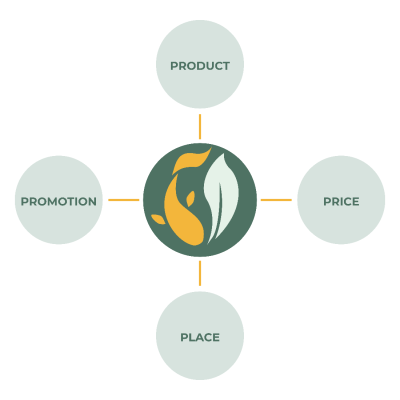
4.6.1 Product
Product policy is the most important of the four pillars of the marketing mix. This category includes all necessary decisions that directly affect goods and services. The product itself is the essential core for a company and should be designed to meet the needs of the customer. Here, not only the technical features such as the shape or size of the product are important. Branding decisions are also an important aspect. What product do we offer our target group? Do we make use of product variants or product differentiation? Our aim is to offer the customer a choice of sizes. This allows us to appeal to a wide clientele and offer a tiered price list. In order to ensure that the animals are kept in a species-appropriate habitat, we do not want to significantly change the size of the aquarium. A more affordable version is to be realised by reducing the number of algae tanks and thus the number of hoses and connections.
4.6.2 Price
In terms of pricing policy, suppliers consider the price they charge for their goods or services. When setting the price, different aspects such as costs incurred, demand from the target groups and competition must be considered. The sales price must be accepted by the customers but remain competitive. What price do we charge for our product? Do we offer discounts? What payment terms do we opt for? The goal is normally to maximize profit. However, since we want to create a sustainable product with GREEN.flow, our focus is to make the product accessible to as many people as possible, and that is usually a question of price. Nevertheless, in order to be able to guarantee excellent quality, we are planning 300€ as the final price for a model. Based on the product modifications already mentioned in the section Product, the price for the GREEN.flow is in the range between 150€ and 350€. We will refrain from discounts, but payment in rates should be made possible.
4.6.3 Place
Distribution policy asks the question of how the product or service can best reach the end consumer. All decisions and activities concerning the route or logistics fall under this point of the marketing mix. Which distribution channel do we choose? Do we cooperate with a distribution partner and hand over distribution to them? It is planned to distribute GREEN.flow both via a dedicated website and via specific shops for aquarium supplies such as pet shops.
4.6.4 Promotion
Promotion deals with the best way to present goods or services, e.g. through classical advertising or social media marketing. A company must make the target group aware of the existence of its products through promotional measures. A particularly attractive offer should be formulated that the customer cannot resist. If the right information is conveyed and the company's own product stands out from the competition, it is more likely to be remembered by the end consumer. Which communication channel do we choose? Do we use classic advertising via TV spots, radio or print media? Do we want to be present on social media channels? Do we present our product at a trade fair? These questions are answered in the next chapter, taking into account the budget plan.
4.7 Budget
The marketing budget - the money a marketing department has available in the course of a business quarter or year for campaigns, operations, advertising materials and target achievement - is one of the fundamental factors in marketing planning. But how much budget a company's marketing department needs to work efficiently and successfully depends on different aspects. The size of the marketing budget is highly individual and depends on a wide variety of factors. There is no universal benchmark for an adequate marketing budget. How much money a marketing department needs to have at its disposal to manage it successfully and achieve its goals varies from company to company and depends, among other things, on the following factors:
- The marketing goals to be achieved with the budget
- The industry/sector in which the company operates
- The target group, their online behavior and the channels they use
- The size of the company and its turnover
- The size of the marketing department
Regarding our marketing budget plan, we have decided to focus on the areas of public relations and social media with a total share of 58%. Based on our target group, which is mainly between the ages of 30-40, we invest with 37% the largest part of our budget in social media. This generation is familiar with social media channels and in the next few years, more and more people who have even grown up with Instagram and co. will join them. However, in order to meet those who are already interested in aquariums, we also want to be present at trade fairs such as the “Aquarana”. There we will introduce the GREEN.flow to customers and make contacts for collaborations. But since these stand fees are very expensive, we have to limit ourselves with the number of fairs. We also want to keep in mind the local market in our marketing plan. Therefore, we try to reach the local market in different ways, for example with flyers and advertisements in newspapers. The overview of the budget allocation shown in Figure 17 is only a preliminary plan, which can and must be constantly changed during implementation and in retrospect.
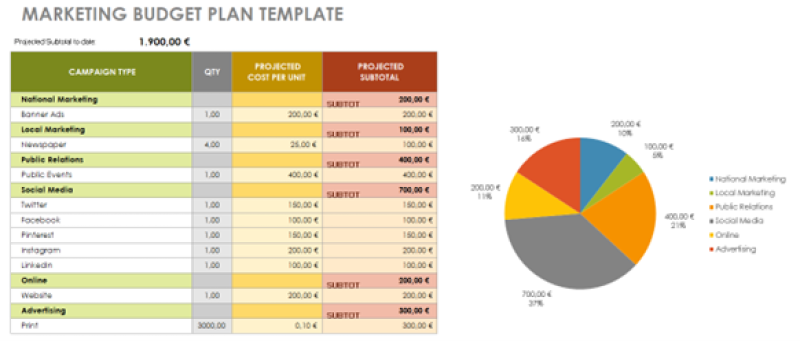
4.8 Strategy Control
Controlling the strategies mentioned in the previous chapters to achieve a large market share is extremely important for a company's long-term existence. Besides reflecting on their effectiveness in the current situation, it is essential to control and adapt them in the future. The ways of marketing and also the interests of the customers can change constantly. In order not to lose touch, we follow the PDCA-Cycle figure, which divides the steps for strategy control into four different phases. These are explained in more detail below.
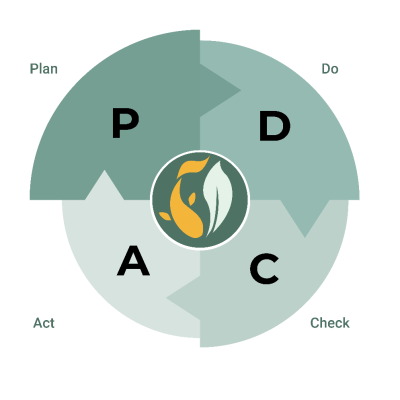
4.8.1 PDCA – cycle figure
- P – Plan
In the planning phase of the cycle, the actual situation is analyzed. For this purpose, figures are compiled and put into context to show the current status. Problems are described and information is collected. As a result, measures are defined that can contribute to the solution, improvement or optimization.
- D – Do
The Do phase includes the execution of the measures in compliance with the time and resource plan. In order to be able to trace this in retrospect, it is mandatory to document the procedure.
- C – Check
Following the Do phase, the Check phase must be used to check to what extent the implemented measures have contributed to the improvement. For this reason, the results are illustrated and checked. If there are deviations from the objectives, the measures are adjusted accordingly.
- A – Act
The fourth phase of the PDCA cycle is the Act Phase. In this phase, the preceding process is reflected. This can result in procedures and outcomes being standardized and used as an impetus for follow-up activities in the company.
4.9 Conclusion
With the market analysis as a basis, we realized that the GREEN.flow product would be a niche product. Since up to now there are only products on the market that offer the individual functions such as the aquarium or the end product of GREEN.flow, our symbiotic system will be the only one of its kind on the market.
Due to this fact, we have realized that it can be a great advantage for us to be the sole supplier of the product. But it also brings the risk with it that it may not find a place in the market. The success of marketing a product always depends on the willingness to buy and thus on the interest, but also on the possibility to buy. To counteract this risk, we have focused our marketing plan on reaching as many customers as possible by promoting GREEN.flow in the social networks and making it possible for almost anyone willing to buy our product through various models and financing options.
In the following chapter, we will discuss how this can be implemented in the context of sustainable production.
5. Eco-efficiency Measures for Sustainability
5.1 Introduction
Companies all around the world are paying more attention to eco-efficiency of the created products. They indicate more value through technology and process changes whilst reducing usage of resources and environmental impact throughout the product’s or service’s life. Eco-efficiency applies to all business aspects from purchasing, production and marketing to distribution. The goal is to reduce the amount of resources such as water, energy or material, as well as to generate less pollution, waste during creation, production and usage of the article. It is also important to consider the possibility of recyclability of the product at the end of their useful life. As we talk about sustainability, there are three important aspects that we can divide this subject into: environmental, economic and social sustainability. Together they define the most sustainable outcome possible [H. Srinivas, 2020].

5.2 Environmental
Environmental sustainability creates a responsible way to co-operate with a planet to keep its natural resources and support global ecosystems to ensure well-being of current and future generations. As our project refers to creating your own way to produce algae, it is an example of sustainable food production [M. Evans, 2020].
5.3 Economical
Economic aspect is a part of a sustainability which focus on usage and protection of resources in order to create long-term sustainable values by optimal use, recovery and recycling. The concept is used to define and explain how valuable natural resources are today and how they can be in the future [R.M. Löf, 2018].
5.4 Social
The last aspect of sustainability is the social one. It is a process of creating a sustainable, successful ecosystem that promotes wellbeing by understanding what people need from the places they live and work in. It combines design of the physical realm with design of the social world. Infrastructure to support social and cultural life, social amenities, systems for citizens’ engagement and space to evolve. Consumers want socially sustainable products. They are more engaged, informed and care about the impact of a product they buy. Companies that are more transparent about their supply chains have reaped the benefits from customers, who are willing to spend more for products that are ethical. That is why companies increasingly partner with social sustainability organizations to become more transparent, make their operations or supply chains more ethical and understand the human cost of business [Adec Innovation, 2022].
5.5 Life Cycle Analysis
Life Cycle Analysis is a method used for quantifying the impact on environment caused by the process of creating and production of a product. The essence of this method is to focus not only on the assessment of the final result of a given technological process, but also to estimate and assess the consequences of the entire process for the natural environment.
Resources
Our goal is to create a product using renewable resources as much as it’s possible.
What is more, we use materials that are reusable, so after the time people don’t want or don’t need it anymore, it can be used again. As well as recyclable, so after the time it won’t be possible to use, it won’t cause any damage to the planet.
Manufacturing
For manufacturing the idea is to allow the customer to assemble the kit himself so the components have to be produced the way that will make it easier to build. For the electrical parts it is important to secure them so it will not cause any trouble in contact with water.
Packaging
When it comes to packaging, we want to use as less material as possible, to reduce waste. Also for the electrical parts it is important to secure them so they will not cause any harm to the customer and fish as well.
Distribution
The goal is to reduce exhaust emissions and pollution that is coming from vehicles with petrol engines. If we decide to distribute our product with typical forms of transport, it will be electric ones.
Use
For right usage of the system it is necessary to use electricity. We have ruled out the possibility of using power from renewable sources in order to decrease the price of the product. Nevertheless, we are not excluding using it in future versions of the product.
For the light we are using the LEDs, which consume less energy than the standard light.
What is more, the whole system, especially pumps will not work all the time but switch on and off at particular part of time.
Recycling
In the situation when any component stops working, the customer will be able to send it back and do not worry about throwing it away in wrong place. The idea is to fix the component if possible or send back the working one and recycle the broken one.

5.6 Conclusion
Situation on the planet changes everyday and thanks to more inventions we are finding more solutions to harm the Earth a little bit less without changing our lifestyle at the same time. That is the rule we follow during creation of our product. Usage of more sustainable solutions, that contain facts like giving components second life or using more sustainable ways of distributing the product, lead to savings, that are beneficial for the company, as well as for the customer himself. The idea of growing your own food is at the same time exciting and eco-friendly, which makes our product even more interesting and beneficial. Apart from the sustainability field, it is important to establish ethical standards that will be elaborated in the next chapter.
6. Ethical and Deontological Concerns
6.1 Introduction
Deontology is referred to as a concept that suggests whether actions are right or wrong according to a clear set of rules. Actions that follow these rules are considered ethical. It’s a fundamental reflection of any population in order to establish its standards, limits and duties. Ethics is a philosophical discipline dealing with moral judgements and is therefore a similar concept to morality [Ing, 2011]. The importance of deontology and ethics in everyday life is therefore not negligible. It contributes to shaping an image of one's market position, contribution, and reliability. If these were neglected, there would be total chaos. As ethical behaviour is of utmost importance when designing a new product, this chapter will cover the different aspects such as ( engineering (6.2)), ( sales&marketing (6.3)), ( environment (6.4)), as well as ( liability (6.5)).

6.2 Engineering Ethics
There are many codes of ethics for engineers, and the following duties of the profession have been taken from the Code of Ethics and Deontology of the Portuguese Order of Engineers (OE),[Ordem dos Engenheiros, 2021]. Following this statement, engineers are expected to demonstrate the highest standards of honesty and integrity. Therefore, according to the National Society of Professional Engineers (NSPE), [National Society of Professional Engineers, 2019], in the performance of their professional duties, they will observe the following fundamental canons, rules of practice and professional obligations :
6.2.1 Guiding Principles
In the course of their professional activities, engineers shall
- Give priority to the safety, health and welfare of the public.
- Provide services only in areas within their competence.
- Make only objective and truthful statements in public.
- Behave towards each employer or client as an honest representative or agent.
- Avoid fraudulent actions.
- Maintain honourable, judicious, ethical and legal behaviour so as to promote the honour, reputation and usefulness of the profession.
6.2.2 Implementing Provisions
- Engineers shall give priority to the safety, health and welfare of the public.
- An engineer may only provide services in the fields within his competence.
- A professional engineer shall make public statements only of an objective and truthful nature.
- A professional engineer must behave towards each employer or client as an honest representative or agent.
- A professional engineer must avoid any fraudulent action.
6.2.3 Professional Obligations
- A professional engineer must observe the highest standards of honesty and integrity in all professional dealings.
- An engineer is encouraged to serve the public interest at all times
- An engineer must avoid any behaviour or activity that might mislead the general public.
- Unless authorized to do so, a professional engineer shall not reveal confidential information relating to the professional activities or technical processes of any client, employer, past or present, or public body on which he or she serves.
- A professional engineer's professional duty must not be subject to the influence of conflicting interests.
- A professional engineer must not use improper or questionable methods or engage in misleading criticism of other engineers in order to obtain employment or to further his or her own career or professional activities.
- An engineer should not attempt to maliciously or falsely damage, directly or indirectly, the reputation, potential projects, professional activities or employment of other engineers. A professional engineer who believes that other professional engineers are guilty of unethical or illegal activities should report such information to the appropriate authorities
- A professional engineer must accept personal responsibility for his or her professional activities, provided, however, that he or she is entitled to claim compensation for services rendered, other than in cases of gross negligence, where the interests of the engineer cannot otherwise be protected.
- An engineer must acknowledge the share of each in the engineering work done and admit the exclusive rights of others.
In short, the purpose of an engineer is to use some knowledge from a wide range of fields to create something new to improve the quality of human life. Mistakes cannot be allowed when it comes to the safety of the users and the devastating consequences they can have. This profession therefore involves great responsibility and takes into account many ethical standards.
6.3 Sales and Marketing Ethics
Marketing is at the heart of all businesses and all other functions depend on it to drive the business forward. It is a business function that interacts most with markets. Indeed, markets are made to sell, and they only exist when they sell! In such a scenario, there are inevitably several players, and a clash is inevitable. Sales ethics are a set of behaviours that ensure that every prospect and customer is treated with respect, fairness, honesty and integrity [P. Juneja, 2015]. The result? In the long run, ethical selling behaviour makes sense: it builds buyer loyalty and trust. Better spending customers, more engaged employees and lower business costs. By taking an ethical approach to selling, you are making a clear statement: you want to sell to customers who want to buy from you rather than selling by any means necessary. Nowadays it is very difficult to find a company that promotes and respects ethical values. Often profit, increased sales and being better than the competition are achieved by unethical means. The tendency is to influence the buyer in such a way that he or she is under the impression that using a particular product will bring many benefits, when in reality the product has no effect. Like other ethical disciplines, marketing ethics is also approached from different angles. There is the virtue perspective, the opportunism perspective, and other perspectives. But as with any other ethics, there is also the difficulty of deciding which agency is responsible for ethical practice. Since there is no single agency responsible for ethics, this gives an individual or a marketing agency the independence to act on its own initiative and be ethical! Unlike other business ethics, marketing ethics is not limited to the field of marketing alone. It influences many aspects of our lives and the development of perceptions in people's minds and the creation of identities, classes and sections in society. The visual communication channels used for marketing sometimes lead to the closure of knowledge, opinions, ideas and beliefs. This creates prejudice in people's minds [Chambre de Commerce Internationale, 2011].
6.4 Environmental Ethics
Over the past two centuries, the world's population has exploded from one billion to over 7.7 billion. And unfortunately, resource consumption has increased with them. This behaviour has put increasing pressure on our planet's capacity to sustain life, forcing humans to deal with consequences such as the growing division between rich and poor and various aspects of climate change. The reason for this is that people have forgotten the value and moral status of the environment and its non-human inhabitants. This is the purpose of environmental ethics. It deals with the balance between social economic, and environmental aspects and tries to be more sustainable in all its actions. Environmental ethics is a branch of applied philosophy that studies the conceptual underpinnings of environmental values as well as the more concrete issues surrounding societal attitudes actions, and policies to protect and maintain biodiversity and ecological systems. There are many different environmental ethics, ranging from human-centred views to more nature-centred perspectives. This is easier said than done. The development mindset needs to change, and concerns should start to deliver more value with less environmental impact. They need to disconnect welfare growth from natural resource use and improve economic and ecological efficiency. Therefore, our group is committed to the following:
- We will discuss and consider environmental ethics for the benefit of our living beings, fish, and seaweed.
- Our system must also be pesticide free and nutrient efficient.
- In this project we will also reduce energy consumption, as well the amount of water used.
- In addition, we will use easily recyclable materials such as bio plastic.
- Moreover, we want our different materials, tank, pump, filter to be easily separated by category (glass, plastic, cardboard) for proper recycling.
- At the same time we intend to create recyclable packaging for transport using the right materials, thus avoiding over-packaging and multi-layered materials that are not recyclable.
- We plan to use as many components from local suppliers as possible or second-hand materials.
6.5 Liability
In general, liability could be divided into two parts. The first is a duty that companies have to their customers. The team must ensure that all components used in the manufacturing process are of high quality and reliable. The aim is to avoid any kind of incident with the product that could cause harm to the user, which also decreases the company's confidence. In order to avoid such risks, the team must ensure that all suppliers are legitimate and certified. In addition, customers should receive a user manual explaining how to use the product correctly and safely. The manual should also contain information on what to do and who to contact if the product or part of the product has been broken or become unusable [C. Donovan R. Belani, H. Loo, 2020]. The other part of the responsibility is a professional responsibility towards the requirements and standards that have been issued by the European Union. Errors must not exist in our symbiotic system between our algae and our fish and for this we will base ourselves on the following points.
6.5.1 Legal liability
We are committed to creating a product that will obey applicable legal rules. We must consider: copyrights, trademarks, and not infringe on existing patents any of these elements.
6.5.2 Criminal liability
Liability that arises from the violation of a law or the commission of a criminal act. Public liability insurance does not cover criminal liability.
6.5.3 Professional liability
In this case it is highly preferable to follow the engineers' code of ethics. A company is liable if its product causes physical or emotional harm to a person. Businesses are also liable for injuries on their property and for any damage resulting from actions taken on behalf of the business. There is a specific type of product liability, called strict liability, which describes who (among manufacturers, contractors, suppliers and retailers) is specifically is liable in cases of defective products [S.E. Sterk, 2008].
6.6 Conclusion
At the end of this chapter, we have been able to deal with the different ethical issues in a more precise way, we now have a better understanding of the problems that arise during product development. As engineers, we have obligations to fulfil within the framework of the code of ethics established in Portugal. Now we know that we must comply with European directives to avoid liability problems: [European Commission, 2022]. In the area of marketing, we now know that our advertising must be clear and must not infringe on the competition. In the area of environmental ethics, we must make a product that respects the environment by reducing the environmental impact. And finally, we must not forget that our product must meet certain European standards. We are committed to all the above issues and will always try to find more ethical solutions using the “trust model” as often as necessary. Based on this analysis we have been able to establish the rules of our ethical project, we can now start the design of our prototype, the development of our project which will be discussed in the next chapter.
7. Project Development
7.1 Introduction
This chapter presents the development of the GREEN flow. It shows the whole process, starting with rough sketches and ideas and ending with a fully defined solution. The chapter consists of six different parts. Ideation is the first section that defines and connects the different components that make up the product. It discusses the black box and the corresponding product ideas that are generated. The second part is Concept. This shows the complete idea of the product and what is involved: elements, requirements, concerns and regulations. Structural Design is the third sub-chapter. In this section, the idea is put into shape. With sketches and a 3D model, the product and the materials that go along with it are shown. After Structural Design comes System Design. Whereas Structural Design focuses more on the design and the appearance of the product, System Design focuses on the components. How they are connected and interact with each other. As the real product is too big to make under these circumstances, a prototype is chosen. In this part, the process of the prototype is shown. Next comes Tests and Results, where the created prototype is tested and the results are shown. Finally, there is the conclusion. This summarises the main relevant points of this whole procedure.
7.2 Ideation
7.2.1 Black Box
In order to better identify the parts that would be connected, this is represented in the form of a black box. Figure 22 schematically shows all inputs and outputs of a system without paying too much attention to the internal working of the system. It shows the electrical pump and the lamp are controlled by the processor by putting it off and on. Depending on the type of lamp and pump that is used, the ideal light intensity and pump flow rate settings have to be researched in order to optimize the system. It is, however, not clear if this option is possible to investigate due to the type of pump and lamp that have to be selected yet.

7.2.2 Structural Sketches
Since a home kit has been chosen, the design of the product is certainly also a key point. Figure 23, 24 shows some sketches of ideas about the product. Especially on how the algae and fish tank could be placed in relation to each other. In addition, there are also form variations presented.


7.3 Concept
7.3.1 Logo concepts
For the design of our logo. We had several different design ideas and concepts. You can see in this section the evolution of our thinking about the colours and shapes of the different logos. After discussion we found a logo that suited us all.


7.3.2 Logo
The logo is part of the product's branding and is an important factor. It not only grabs the attention but can be memorable, distinguishes you from your competitors, reflects a part of the image and forms the basis of your brand identity [A. Westgarth, 2018]. The logo and the name of GREEN.flow represent what the product stands for and what this can mean for the user. The GREEN.flow logo (Figure 27) consists of three main elements. These three elements represent what our product aims to achieve; a symbiosis between two organisms that can lead to a circular system. The circle representing the fish and algae shows the symbiosis and the small-scale circular ecosystem that is the main purpose of our product system. This aim is not only represented by the logo, but also by the name. Our product works with a water circulation that is beneficial for both organisms. This is done by means of a current that runs through both systems, creating a flow between the two tanks. The 'GREEN' indicates the focus that we try to put on our project. Whereby not only the production is done as ecologically as possible, but whereby the aim is also to provide the user with an ecological mindset.

7.3.3 Target group
It was decided to focus on the home use of the product. This by users who have the space and time to immerse themselves in a slow-moving but long-lasting project. Our users are people who have green fingers and like to occupy themselves with nature in various new forms. The target group that this product is designed for, would like to bring a new view on the world and contribute to the path towards a green society. The chosen target group meets the following characteristics:
- Age 25-70
- Located in Europe
- Ready to look for ecological alternatives to a traditional way of life
- Interest in sustainability
- Interest in cooking and experimenting with ingredients

7.3.4 Elements
As discussed above, the algae and the fish are the two main factors in our product. Our product connects these two organisms and creates an advantageous situation for both. The system between these two aquariums in which the nutrients in the water serve as nutrients and the water is purified at the same time is the main function. In addition, the algae can be harvested for home use and can be processed by the user in various ways. The latter is the secondary function of the product.
- An aquarium for the fish
- An aquarium for the algae
- Sensors and elements to ensure a good environment for the growth of algae and fish
- A tube to allow the water to flow from one tank to another
- An efficient filter to harvest the algae
- A control panel that can control all the sensors
- An app or website that allows you to control the sensors remotely and that provides notifications in case of unusual situations
7.4 Structural Design
In Figure 29 the first version of the GREEN.flow can be seen.

7.5 System Design
7.5.1 Choice of Components
7.5.1.1 Microprocessor development board
The ease of use of the GREEN.flow is one of the most important features of the product. To ensure this, it is necessary to make the handling as simple and compact as possible. The aim is therefore to be able to control functions such as the detection of water leakage from the tank, the regulation of the light and the operation of the pump via an app. The heart of this process is the microcontroller developer board. The manufacturers of the Arduino and Raspberry Pi products are probably the best-known providers. But since Arduino has published the functionality of its boards, there are many replicas on the market that offer similar functions and are often cheaper. The Table 10 shows a comparison of different developer boards.
| Name | Wireless Connection | Dimensions | Other Characteristics | Price [€] | Photo |
|---|---|---|---|---|---|
| Arduino Nano Every | None | 18 mm x 45 mm; 5 g | USB connector (Mircro USB)/ Pins (Built-in LED Pin: 13, Digital I/O Pins: 14, Analog input pins: 8, PWM pins: 5)/ Communication (UART: RX/TX, 12C: A4(SDA), A5 (SCL), SPI: D11 (COPI), D12)/ POWER (I/O Voltage: 5V, Input Voltage (Norminal): 7-18 V, DC Current per I/O, Pin: 15 mA)/ Clockspeed/ Processor (ATMega4809, 16 MHz)/ Memory (ATmega328P: 6 kB SRAM, 48 kB flash 256 byte EEPROM) | 11.00 |  |
| Arduino Nano 33 IoT | Wi-Fi, Bluetooth | 18 mm x 45 mm; 5 g | USB connector: Mircro USB/ Pins (Built-in LED, Pin: 13, Digital I/O Pins: 14, Analog input pins: 8, PWM pins: 5, External interrupts: All digital pins)/ Communication (UART: RX/TX; 12C: A4(SDA), A5 (SCL); SPI: D11 (COPI), D12)/ POWER (I/O Voltage: 3.3V; Input Voltage (Norminal): 5-18 V; DC Current per I/O Pin: 7 mA)/ Clock speed (Processor: SAMC21G18A, 8 MHz)/ Memory( SAMC21G18A: 256 kB SRAM, 1 MB flash) | 18.80 |  |
| Raspberry Pi pico RP2040 + Adafruit AirLift-ESP32 Wi-Fi Co-Processor | Wi-Fi | 21 mm x 51 mm | Dual-core Arm Cortex-M0+ processor, flexible clock running up to 133 MHz/ 264 kB on-chip SRAM/ 2 MB on-board QSPI Flash/ 26 multifunction GPIO pins, including 3 analogue inputs/ 2 × UART, 2 × SPI controllers, 2 × I2C controllers, 16 × PWM channels/ 1 × USB 1.1 controller and PHY, with host and device support/ 8 × Programmable I/O (PIO) state machines for custom peripheral support/ Supported input power 1.8–5.5 V DC/ Operating temperature -20 °C to +85 °C/ Castellated module allows soldering direct to carrier boards/ Drag-and-drop programming using mass storage over USB/ Low-power sleep and dormant modes/ Accurate on-chip clock/ Temperature sensor: Accelerated integer and floating-point libraries on-chip | 7.99; 12.23 |   |
| ESP32 AZDelivery | Wi-Fi, Bluetooth | 28 mm x 56 mm | USB connector: Mircro USB/ Pins: 38/ POWER (I/O Voltage: 3.3 V; Input Voltage (Norminal): 5-18 V; Current per I/O Pin: 15 mA); Average working current: 80 mA)/ Memory (520 kB SRAM, 4 MB flash) | 9.99 |  |
In terms of cost consideration and the Wi-Fi connection function required for the app, the ESP32 AZDelivery developer board was chosen.
7.5.1.2 Breadboard
A breadboard is needed to connect the electronic devices with each other. A solution was chosen that has the right size of 400 contacts and has an affordable prize.
| Name | Characteristics | Price [€] | Photo |
|---|---|---|---|
| Breadboard Plugboard Mini | for Arduino /Raspberry usage/ 400 contacts | 0.64 |  |
7.5.1.3 Water Leak Sensor
Measuring the water level is not only necessary to detect possible leaks in the water tank or the pipe system, to prevent flooding and to protect the surrounding electronic devices, but also to ensure the survival of the fish. There are already many smart products on the market that can be operated via an app. For choosing the right product for the application in the project, it is therefore important to consider whether it makes more sense to control the water leak sensor via the microcontroller or to provide the user a second, already developed app.
| Name | Characteristics | Price [€] | Photo |
|---|---|---|---|
| WAVGAT Water leak sensor | for Arduino/Raspberry Pi usage/ Operating voltage: DC3-5 V/ Operating current: less than 20 mA/ Sensor Type: Analog/ Detection Area: 40 mmx16 mm/ Production process: FR4 double-sided HASL/ Operating temperature:10 ℃-30 ℃/ Humidity: 10 % - 90 % non-condensing/ Product Dimensions: 62 mm x20 mm x8 mm | 1.18 |  |
| Tuya Smart Leakage Alarm | works with amazon alexa / google assistant | 27.40 |  |
| Water level alarm | power supply: 3 x LR44/ 70 mm x 50 mm x 20 mm/ attachment with suction cups/ no Wi-Fi/Bluetooth connection | 10.99 |  |
| Water Level Sensor - Normaly Open | switching current: 1.0A DC max./ switching power: 10 VA max./ contact resistance: 150 mΩ max./ contact material: rhodium/ operating/release time: 0.6 ms/0.1 ms max./ max. voltage: 100 VDC/ breakdown voltage: 250 VDC/ operating temperature: 0 to +70 °C/ materials: polyamide, polypropylene foam and rubber/ length of lead wire: 70 mm | 6.27 |  |
The decision regarding the water leak sensor was made in favour of the WAVGAT Water Leak Sensor. This sensor is unbeatable in its price. Another decisive factor was that the sensor can transmit the data it detects to the microcontroller. Since we decided to combine all controllable functions within one app, we were able to exclude products that are not connectable with the rest of the system.
7.5.1.4 Lamp
For space and energy saving reasons, it is planned to supply the algae and the fish with the same light source. For this reason, the choice of lamp has fallen on Amatslite Super Slim LED Type 2. The mounting on the rim is not dependent on the size of the tank, so the lamp can be mounted in a way that both tanks are illuminated.
| Name | Characteristics | Price [€] | Photo |
|---|---|---|---|
| Amatslite Super Slim LED | Type 1 (Tank Size: 15-30 cm, Power: 5 W, Lumen: 6091 m)/ Type 2(Tank Size: 30-60 cm, Power: 10 W, Lumen: 12001 m) | Type 1: 8.16/ Type 2: 10.62 |  |
| Clip-on Fish LED Lamp A400 | Power: 11 W, Tank Size: 40 - 50 cm, Adjustable holde | 11.76 |  |
7.5.1.5 Water pump
GREEN.flow is a closed system in which water must be led from the fish tank into the algae boxes. To realise this, a pump is needed. Since neither large distance must be covered nor large amounts of water have to be pumped at the same time, a model was chosen that fits into the budget of the project and can be controlled with the microcontroller.
| Name | Characteristics | Price [€] | Photo |
|---|---|---|---|
| 12 DC Dosing Pump | Engine SPEED: 5000RPM/ Volts: DC 12 V/ Current: 80 mA/ Relative humidity <80 %/ Temperature: 0-40 ℃/ Flow rate: 0-100 mL/min/ Rotate speed: 0.1-100 rpm/ Stick Size (Φ x H): Diameter 27.6 x height 37.9 (mm)/ Head size (Φx H): diameter 31.7 x height 20.1 (mm)/ Equipped with pump tube (ID x OD): 2.5 x outer diameter of the inner diameter of 4.7 (mm)/ Weight: 89 g/ Horizontal head: 25 m, pump suction: 2-3 m (test with water)/ Direction: you can connect the flow direction through the positive and negative | 3.33 |  |
7.5.1.6 Fish Feeding System
The feeding system is a component that greatly simplifies the handling of the GREEN.flow. It allows the user to leave the aquarium alone for a few days and takes away the worry about possibly forgetting to feed. It also ensures a constant amount of food, so that neither too much nor too little food enters the aquarium.
| Name | Characteristics | Price [€] | Photo |
|---|---|---|---|
| Smart aquarium mini automatic fish feeder AF-2019B 200 ml | Battery: 2x AA/ Capacity: 200 ml/ Feeding times/Day: 4/ Function: LCD screen | 18.91 |  |
7.5.1.7 Fish Tank
For the choice of our fish tanks, we finally chose to go for a plastic aquarium without a lid to reduce its price and its use. In addition, we will use a transparent plastic and a good size tank for the comfort of our fish. This kind of container is quite easy to find, and we don't have many requirements. So, we will look for this tank in local shops in Porto.
| Name | Characteristics | Price [€] | Photo |
|---|---|---|---|
| Prosperplast Recipient in plastic | You can just use a large transparent plastic container without a lid | 5 |  |
| Ferplast Aquarium in plastic | inexpensive with many different sizes/ Ex: Medium 2,5 L/ 23,2 cm x 15,3 cm x 16,6 cm | 7-25 |  |
7.5.1.8 Algae Tank
For the algae tanks we looked at several possibilities. Either simple tanks of smaller size than for the fish, or water bottles that we can customise. In the end, we decided to go with water bottles as this is the most economical, easiest to find and easiest to transform. Our goal is to cut the bottles, to use filters at the ends of the bottle to filter the water to purify the algae and to reuse it in the fish tank. Opening the bottle cap will allow us to do this. This principle allows us to reuse our own water bottles, not to buy anything extra and to take into consideration the environmental problems.
| Name | Characteristics | Price [€] | Photo |
|---|---|---|---|
| Tank plastic | For the algae tank you can use different transparent plastic, preferably PET. Afterwards you can also decide on the number of tanks and the size./6L, 25.3 cm x 15.8 cm x 15.5 cm | 5.62 |  |
| Bottle of water | A lot of big water bottles, which we can transform to our liking. | 0.20 |  |
7.5.1.9 Pipes
We need a pipe, to bring the fish excrement into each algae tank as nutrients. But also, to return the purified water from the algae into the fish tank. For this purpose, we decided to use a silicone tube, which is wide enough to allow water to pass through and long enough to be cut to size. This way the price of the whole pipe will be cheaper.
| Name | Characteristics | Price [€] | Photo |
|---|---|---|---|
| Air pump tube | PIPES 4-6 mm/ 244 cm/ AMTRA, transparent silicone | 1.03 |  |
7.5.1.10 Sieve for algae harvest
For the choice of sieves, we looked for different sizes and shapes in order to choose the best compromise. After discussion we decided to use a sieve with very fine holes so that the algae could not pass between the holes. We will take the sieves in the form of paper or fabric so that we can model their shapes in our algae and fish tanks. For the choice of shops, it is important to find inexpensive materials, locally in Porto or on second hand sites to be cost conscious and to keep our values eco responsible.
| Name | Characteristics | Price [€] | Photo |
|---|---|---|---|
| Harris 24cm Filter papers | Depend of the number 2-10 |  |
|
| WEAVERBIRD Aquarium | Inflow Inlet Filter 12 mm | 6 |  |
| Strainer Fine Mesh | Pcs Ultra-fine Mesh | 8 |  |
7.5.2 Detailed Schematics
Figure 29 shows the first draft for a system diagram for the Green.flow system. It shows how every component is enclosed by manually operated valves in order to replace it or to do maintenance. Figure 29 also shows an agitator in algae tank 1. Only one agitator is installed in the prototype in order to research whether an agitator is needed or not. Every tank has its own drain to let water out of the tank without draining the whole system. Both the inlet and outlet pipe to the algae tanks contain a filter in order to keep fish faeces in the fish tank and the algae in the algae tank. For the product phase the valves may be upgraded to automatic valves, controlled by the leak sensor, to close off the fish tank to keep it from drying out in case of a leakage.

7.6 Packaging
7.6.1 Fish and Algae in our packaging
7.6.1.1 For the Fish
To start our research on this part talking about the packaging of our product we did some research on the possibility to transport our fish inside our kit. We learned that fish can only be transported in plastic bags. There are special bags for transporting fish that are made of safe materials and have rounded edges, which protects the fish from getting stuck in a sharp corner, and the thermal insulation of the bag should be checked. In addition, during transport, the fish need oxygen, so the bag should be filled with water to 1/3 of its height. Such a procedure will provide the residents of the bag with the necessary air for only a few hours. It should be remembered that the bag containing the fish should be transported in a stable vertical position. It is preferable to put it in a box because darkness reduces the stress of the transported animals [Aquael blog, 2019]. After a lot of research into the needs and risks of transporting fish in a plastic bag. We have concluded that we cannot include our fish in our kit due to the lack of oxygen, temperature control, potential shocks which are too great a risk to the health of our fish. Moreover, a fish can only survive for a few hours in this type of habitat, which does not correspond to the average shipping time of a parcel.
7.6.1.2 For the Algae
On the other hand, we have carried out the same research to send our live spirulina strains in our kit and we have noticed that their shelf life in the packaging is of the order of a few days and not a few hours. Indeed, live spirulina needs heat, light, and agitation to survive. It will only survive in transport for a few days maximum. It is therefore important to prepare the culture system before purchase and to take care of the seeding as soon as possible after receipt, which we will not fail to specify in our instructions. A live spirulina kept in the shade in a closed bottle will survive less than a week. So finally, if our kit is delivered quickly and we tell users not to delay in setting up the kit at home. We can then include the live spirulina cultures in the final kit. In this way we avoid our consumers having to procure it themselves. This makes life easier for our consumers and allows us to verify the quality of our spirulina which will be used for food purposes [la spirulerie, 2022].
7.6.2 The packaging of our kit
7.6.2.1 Dimensions of our packaging
In this kit we have several components. The aquarium for the fish, the aquarium for the algae, the lamp for the cultivation of our algae. The algae strains will also be included in our kit as seen before. Not forgetting all the electronic equipment to operate the symbiotic system and the instructions for use. Of course, we must optimise the space to limit the overpacking. In addition, the larger our packaging is, the less kit we can fit into the same transport space, the more greenhouse gases will be emitted because of the greater need for space and the greater use of fuel. So, we decided to use the inside of our fish tank, which is the largest element of our kit, as a tank for the other components of the kit. The final dimensions of our kit will therefore correspond to the dimensions of our fish tank only. Furthermore, this allows our components inside the aquarium to be protected from any possible shocks and jolts due to transport.

7.6.2.2 Principle of our packaging
It was very important for us to give meaning to our packaging to respect the values of our project that we have undertaken since the beginning. So, we wanted to find a suitable solution that would allow us to use our packaging in a way that would have the least possible environmental impact. Our ideas: - To start with we wanted to use the shipping box of our package as a support for our kit. This way the box could be transformed to hold the tanks for the algae and the electronics. It was a very interesting idea, only our product being a product containing water we could not allow us to use cardboard which would risk humidifying our box, but cardboard is the most eco-responsible material in this type of packaging. Moreover, this kit must be aesthetic because it aims to be exposed in the houses of our consumers. - Our second idea was to be able to return the package when it arrived so that we could send it back if we had any problems, which is a good idea for reusing packaging without wasting it. So, our packaging would be double sided, one side for shipping and the other side to be sent back. However, as we have seen before, seaweed cannot survive for more than a week in its packaging. Therefore, we have rejected this idea and confirmed that our customers would not be able to return their packages because of the living things in them. - So, our third idea was the right one and the one we chose to make in the end. We wanted to use the most eco-friendly materials and reuse our packaging as much as possible, while at the same time providing a strong, functional package that was appropriate for the product it was packaging. So, we researched strong and reusable materials for our primary box, which was corrugated recycled cardboard. For the secondary box packaging we researched packaging made of seaweed to prove to our consumers the importance of the seaweed that they will grow in the kit afterwards. And for our wedging we went for a biodegradable and edible packaging made of wheat and barley in order to feed our fish. Our idea is to create the most functional packaging possible, using biodegradable, recyclable, or recycled materials to respect our brand values.
7.6.2.3 Material of our packaging
One of the most important factors in the choice of materials is undoubtedly the goods themselves. The primary function of packaging is to protect the goods during transport. Therefore, depending on the type of goods to be transported and their specific characteristics, whether fragile, large, or long-lasting, you should not choose just any material to package your product. Packaging can be reused. This means that it is no longer a question of producing disposable packaging, but rather a durable protective solution that guarantees the safety of goods throughout their handling and transportation. This is called the second life of packaging. The choice of materials is therefore crucial, as they must offer both a protective and durable solution. The packaging must also be easy to transport, lightweight, impact or water resistant and offer a sufficiently long service life, even after several uses [Creopack, 2021].
- Primary recovery packaging
For our primary packaging that will allow us to transport our entire kit, we have opted for corrugated cardboard. Because cardboard, if it is adapted to the product, remains the king of protection: adaptable, handy, light and solid, it combines all the advantages. Indeed, the wrong choice of cardboard can create risks for our goods during shipments: what is more, a sunken or damaged cardboard box risks disappointing the consumer and harming our customer experience. There are several ranges of cardboard resistance, which are determined according to the weight and type of the product. They must be chosen according to the thin or thick grammage, double or triple corrugated cardboard, etc. We have therefore chosen to start with a corrugated cardboard box with double corrugation which corresponds for medium and fragile products, up to 50 kg of load. For solutions based on cellulosic material (wood sector), the paper pulp industry is now able to produce them using recovered paper. However, with each recycling operation, the quality of the fiber decreases, it can only be recycled, depending on the sources, from 5 to 25 times depending on the desired materials. It is therefore essential to introduce virgin fibers into the manufacturing process of our final cardboard [La Rédaction, 2018].
- Secondary algae packaging
To make our consumers aware of the importance of algae in the future we have decided to use biodegradable packaging made from algae for the smallest elements within our primary packaging such as electrical equipment. Algae fibres can be used as a raw material in the manufacture of paper and packaging. This replaces petroleum-based plastic with algae, a renewable biomass that captures 960kg of CO2 per tonne and does not consume water when it grows. Based on the dramatic and terrifying fact that 500kg of plastic ends up in the oceans every second, and certainly as much in nature, which corresponds to about 10% of the annual production, we want to develop a packaging with a positive impact on the environment from a renewable biomass, without the use of pesticides or insecticides. To demonstrate to our consumers that seaweed is not just a food source but also very interesting in many other areas such as packaging. We have chosen a packaging made of seaweed for our secondary packaging in order to make the buyers of the kit aware of the importance of our symbiotic project with fish.
- The edible wedge
For the wedging we have opted for edible packaging indeed finished bubble wrap and polystyrene plastic very bad for the environment. In addition, the second hand offered is produced and essential for our team because we want to offer an ethical solution that also makes life easier for our consumers. No need to buy fish food when you start using the kit, just use the packaging itself. Dunnage particles, also called dunnage chips, are bulk dunnage materials commonly used to prevent damage to fragile objects during transport. They are designed to snap together when compressed and to flow freely when not. The most common shapes are like a half round. We have chosen to use barley and wheat wedging particles from the brewing process, so it comes from plant sources rather than petroleum-based polystyrene and it is non-toxic. In addition, instead of poisoning the environment, this biodegradable packaging will be able to feed the fish in our kit. Being biodegradable and non-toxic, they are also safe for humans and pets. The starch-based packing particles are more soluble in water. There are still disadvantages compared to polystyrene are less resilience, higher density, dust formation, potential rodent attraction, and higher price.
7.6.3 Elements of our packaging
7.6.3.1 Closure
For the closure of our primary packaging, we have opted for an easy-open mechanism in the form of a tear strip. When the packaging is bulky and difficult to open without using a knife or scissors, it is better to use easy-open mechanisms. The opening of a product is essential in the manufacture of the packaging as our package cannot be returned due to the lifetime of the algae, we can use an opening that does not need to be resealed. A tear strip must be torn to allow the product to be opened. It usually has a tab and a tear line for easy removal. It is very suitable for our product as it can prove the tamper evidence of the package as it can only be opened once.
7.6.3.2 Ink
To remain in line with our environmental values for the printing of our packaging, we have opted for vegetable inks rather than mineral ones. Indeed, to create beautiful packaging and elegant boxes, printing is an essential step, which requires the use of inks. However, these inks are composed of solvents that are very harmful to the environment. Therefore, we prefer to use vegetable-based solutions, which have a reduced environmental impact and are of excellent quality. They are less polluting and more environmentally friendly Choosing vegetable-based inks for our printing enables us to work in a more environmentally friendly way. Thanks to their composition, which is more ecological, they pollute less. Unlike conventional mineral inks, they have a vegetable base, such as soya, flax, and rapeseed. They are therefore made from renewable resources or raw materials, which is not the case with the toxic substances used for mineral inks (lead, oil, mercury, and arsenic, for example). Properties equivalent to those of conventional inks In fact, vegetable inks have similar properties to traditional inks. The only difference is in their composition. Thus, their durability, rendering and UV resistance are equivalent. Nevertheless, it is noticeable that these vegetable products offer better colour transfer. They are more intense, more brilliant. There is also greater stability between the water and the ink [CNC-Packaging, 2020].
7.6.3.3 Label
A good shipment starts with solid packaging. However, mailing labels offer an extra guarantee for safe transport and correct storage. It is best to stick the shipping labels on the side of our box, not on the top, as boxes are often transported in stacks and would therefore make your labels invisible. The “shipping labels” are specially designed for the e-commerce sector to make shipping even easier. The shipping labels contain all the information you need: the delivery note or invoice, the shipping address. In addition, it is possible to add a packing label which gives instructions to the sender or recipient of your package on its contents [Rajablog, 2019].
7.6.3.4 Glue point
We decided not to use glue dots for our packaging. Indeed, glue dots are harmful for the recycling of corrugated cardboard and for the environment. There are transport boxes without glue dots that we will use for our packaging which works with a folding system. Glue less packaging has its place in eco-design because it reduces waste directly at the source. You can take advantage of this to adjust the size and shape of your packaging to avoid voids and waste. Flexible, resistant, and capable of supporting the same original designs as all other types of packaging, glue less packaging loses none of its character.
7.6.3.5 Design of our Packaging
The visual design of your packaging is an important part of the success of our product. Designing your packaging contributes to a unique customer experience, which is essential for building customer loyalty. By choosing quality and innovative materials, you will not fail to stand out. The design of the packaging is an integral part of the brand's identity and allows us to stand out.
7.7 Prototype
For the prototype we were provided with necessary components and materials, thanks to what we could build a well-functioning prototype.
The prototype consists of two glass tanks, connected with pipes to create a well-functioning system. One of the tanks is used for algae and another one is for fish. The fish tank is equipped with pump and two sensors: water level and temperature. The pump is connected to the pipe which goes to the algae tank. The algae tank is illuminated with LEDs and equipped with filter preventing the unnecessary material to get through. From there, another pipe leads back to the fish aquarium, creating a circulation for water.
7.7.1 Development of the electrical circuit schematic
7.7.1.1 Preliminary circuit schematic
Since the final product GREEN.flow is to be controlled via a smart system, it was important for us to test the basic functions in our prototype. For this reason, we have drawn up a preliminary circuit schematic (Figure 37). Based on their properties, the sensors, the relay, the water pump, the LED RGB driver respectively the LED RGB strip are connected to the microcontroller and the power supply. The circuit schematic shown in Figure 37 was created on the basis of the submitted list of components and had to be adapted and updated in the process of prototype development. More on this is explained in the section “Final circuit diagram”.
Since the water level sensor works like a switch, it is only connected to an output and a ground pin. Accordingly, either the “HIGH” or “LOW” signal is sent to the microcontroller and the user can check if the water level is too low or high enough.
Compared to the water sensor, the DS18B20 temperature sensor transmits exact temperature data and therefore requires an additional pin to read out these values.
It gets a little more complicated when connecting the relay. In addition to the VCC and GND connections for power supply and receiving return values, the double relay is connected to two output pins in order to be able to control the two connections separately. With these two connections it should be possible to close the circuit of the pump and thus make it run, as well as to supply the LED RGB driver with power so that the LED can be switched on and off. Both the LED and the pump should be powered by the same 12V power supply.
The WiFi ESP-WROOM 32 microcontroller is driven by a battery. Since it is planned to control the microcontroller via an app, this is an advantage to make it more independent.

7.7.1.2 Modified circuit diagram
Due to the components finally provided, the schematic of the prototype had to be adapted during the development process. The final circuit diagram is now shown in Figure Figure 37.
Compared to the preliminary circuit diagram, the connection between the relay and the power supply for the pump and the LED has changed significantly. Since the pump received cannot be operated with 12V as initially planned, but now requires 230V, the light and pump can no longer be operated with the same voltage source. For this reason, it no longer makes sense to control the LED using the relay. However, as the LED RGB driver can also be controlled directly via signals using the microcontroller, this is not a major problem. The pump is still switched via the relay.
However, a problem has developed as a result of the integration of high voltages due to the operation of the pump and the fact that the components are located close to each other. The switching and data transmission of the surrounding parts is influenced by the high voltage of 230V and thus no longer reacts according to the programmed commands. To counteract this problem, two 10kΩ resistors and a 47 μF 50 V electrolytic capacitor were used.

Using of the above components did not lead to the desired result. For this reason, we were not able to test the prototype until the report was completed. However, in order to be able to get the prototype running for a long time, we have taken care of the procurement of a 12V pump. This will ensure that there is no further interference between the components.
7.8 Test & Results
To make sure components and connections between them work correctly we have conducted number of tests which helped us specify proper operation of the system.
We performed a test in Arduino program in two aspects: correct functioning of the appearing notifications about water level and value of the temperature in the fish tank, as well as correct functioning of light and pump switches.
What is more, the test that was needed to be performed was to check if the system we assembled works correctly, above all: pipes’ connections, water filters and general flow of the water between two tanks.
The basic operation of the programme with which the prototype is driven is shown in the Figure 39. Input is requested from the user and data is returned to the user. The corresponding code is explained in more detail in the following chapters.

7.8.1 Water level and temperature
The coding used in Arduino for receiving information about water level is shown in the figure Figure 40 below.

The result is as follows. If the water level in the fish tank is too low, the information about it appears. The user is only informed when the status of the sensor changes. The swimmer is either at the bottom and there is not the required amount of water in the tank or at a higher level which means that there is enough water.
When it comes to temperature, the information given is the value of it. All of the notifications are shown in the Figure 41 below.

7.8.2 Light and pump switches
As mentioned before, to give the user the opportunity to control aquaponic system remotely, we decided to take into account the light and pump switches in program. The code to achieve this option is shown in the figure below.
As soon as the microcontroller receives the signal to switch on the pump, a while loop is started. As a result, the pump does not run all the time. This makes the system more efficient by saving electricity and balancing the water flow, which is affected by pipes of different thicknesses. It furthermore prevents the hopper from overflowing. To create a harmonious water flow, 3 seconds was chosen for the water flow time and 15 seconds pause (Figure 42). In the loop, it is also queried whether the user has made any further entries. If the user wants to switch off the pump, the while loop is interrupted with the command “break”.

The user is able to turn the light on and off inside and outside of the pump operation. In the code, this was realised by a simple additional “if” query (Figure {ref>flabel43}). The RGB LED allows the exact colour tone of the light to be set. A blue-violet colour tone with the RGB code 108, 17, 70 was selected here. This colour tone favours the growth of algae.

7.8.3 Water flow
Finally, the test of the assembled system was conducted. The prototype of the main product is shown in the figure below.
- (Photo of the prototype)
It was important to check if the components work together properly to create a functioning and, what’s the key aspect, safe aquaponic system. Electrical components were separated to make sure that there’s no possibility of contact with water, what could cause danger. All the pipes were precisely connected to avoid any leak. Used filters prevent from getting through any unwanted materials. As the result of all actions mentioned before we get a well performing system, ready to work with living organisms. For the main product the goal is to connect arduino with the application which user could install on his mobile phone and easily check if the aquaponic system he/she owns work correctly. The design of an app was shown in the chapter 7.9. The user can check if the water level in the fish tank isn’t too high or too low. Similarly with the water temperature in the tank, the information about its value appears in the app. Thanks to that if any leak appears or system breaks, the user can react faster. In future versions of a product, we are considering to take into account the possibility of adding automatic feeder for fish.
7.9 The App
We consider the application as an additional element of our product. Thanks to it, customer can remotely control his/her aquaponic system.
User can sign into his/her account and check if everything works correctly. We take into account a possibility of switching off and on: a light and a pump.
What is more, he/she can check the water level and temperature in the fish tank. If it’s too high or too low, a notification appears on the screen. That helps the user react faster to any leaks or failures.
In future we consider adding automatic feeder’s controller, so with one button it will be possible to remotely feed the fish.
Initial design of an app is shown in the figures below.


7.10 Conclusion
In this chapter, we were able to put words and pictures on the essential parts of the development of Green.flow, for example the structural drawing, the black box, the list of components and the packaging part were successfully done and allowed a certain identification of our project.
The development of the prototype was the most time-consuming and labour-intensive stage. It started from the beginning of the search for components. As difficult as the whole assembly was, it is seen as a success. Indeed, having no knowledge of electronics, our team had to mobilise and redouble their efforts to obtain a result. We threw ourselves into the unknown and we were able, in the end, to fulfil the main requirements concerning the viability of our living beings. We have been able to overcome many problems that have arisen and bring them to logical solutions. Nevertheless, due to procurement reasons, we were not able to test the prototype with all its functions by the time the report was completed. Still, we are confident that a functional prototype can be demonstrated by the time of the final presentation.
In conclusion, this chapter gave us a more realistic and clearer picture of the project in general. Even though the team encountered difficulties during the project, the dedication of each member and the cooperation led to the realisation of a feasible, sustainable, legal and ethical product. In this way, the Green.flow prototype came into being and enabled us to expand our knowledge.
In the following chapter, the future development of the project is described, as well as an open discussion that will present the conclusions and the prospective that the team drew during this project.
8. Conclusions
8.1 Discussion
The objective of Green.flow was to design and develop a new environmentally friendly product that would be viable on the market. Indeed, the aim of our project was to create a symbiotic system taking into consideration algae and fish in order to avoid excessive consumption of water and nutrients.
- How is this possible ?
The fish excrement is used to feed the algae. The algae are used to purify the water for our fish in order to reuse the water and thus save it. Their symbiosis makes it possible to find a compromise and limit the consumption of these two living beings. This educational and fun kit therefore helps to raise consumer awareness of existing harvesting techniques. We wanted to create a complete kit that would allow our users to enjoy fish as a pet while being able to harvest algae and their products in the same way.
- To complete our project we introduced other disciplines to make it more complete.
- Firstly, a detailed marketing plan was created to specify competitors, product strengths and weaknesses and target customers.
- Secondly, the team studied sustainability by researching sustainability regulations, eco-efficiency solutions and analysing life cycle assessment.
- Thirdly, various ethical and deontological concerns were analysed.
- Fourthly, regarding the final deliverables, we produced a number of communication materials such as poster, flyer, video presentation, online application, Leaflet and a user manual with instructions.
Each part is explained and detailed in this report. Therefore, all the initial objectives have been achieved, except for the final results of the prototype due to the lack of time after the reception of the living beings.
- Indeed, the question we are now asking ourselves is:
Will our kit work properly in the future? How many fish will it take to feed the entire algae colony? How often do the algae grow? Is our kit sustainable over time? In the end, we successfully achieved the objectives imposed by the project, and we also fulfilled our personal objectives : to develop ourselves, to live an unforgettable experience both academically and culturally. During this project, we joined forces to achieve our goals and did our best to meet the project deadlines. ISEP offered us the opportunity to carry out a very well structured project with a seamless follow-up while sharing the experience with a multicultural team. This has allowed our team to grow in terms of project management and technical skills in our respective fields of study. However, there is always room for improvement. We will comeback to this in more detail in the section on future development.
8.2 Future Development
In this project, our team has done its best to develop Green.flow. However, we believe that we can always continue to improve our project. Indeed, further development is needed to transform the prototype into a product ready to be marketed. The Green.flow prototype was limited by time, budget, and insufficient knowledge in some technical areas. This means that improvements can always be made.
- The following aspects can be taken into account for future development:
- Testing the evolution of the algae.
- Think about an automatic system for feeding the fish.
- Create an application for the online purchase of our product.
- Find a solution for transporting the fish, perhaps in partnership with pet shops.
- Unordered List ItemEstablish a wireless and waterproof connection between the electronic components for a more visual and practical appearance.
- Add electronic components such as an LCD screen with data for battery, water temperature and algae culture.
- To further develop the application to provide multiple functionalities for our consumers.
- To check the quality of the materials used for the product and the packaging and thus to surround ourselves with good suppliers with certain ethical values.
To conclude, and in order to finalize our project, we can think about the production of our product. It is mainly about launching different product lines, each with a different approach. We could design simpler, more advanced, cheaper and more functional versions, as mentioned before. Finally we are proud of the results, we were able to make a prototype and elements around that make GREEN.flow even more realistic.


